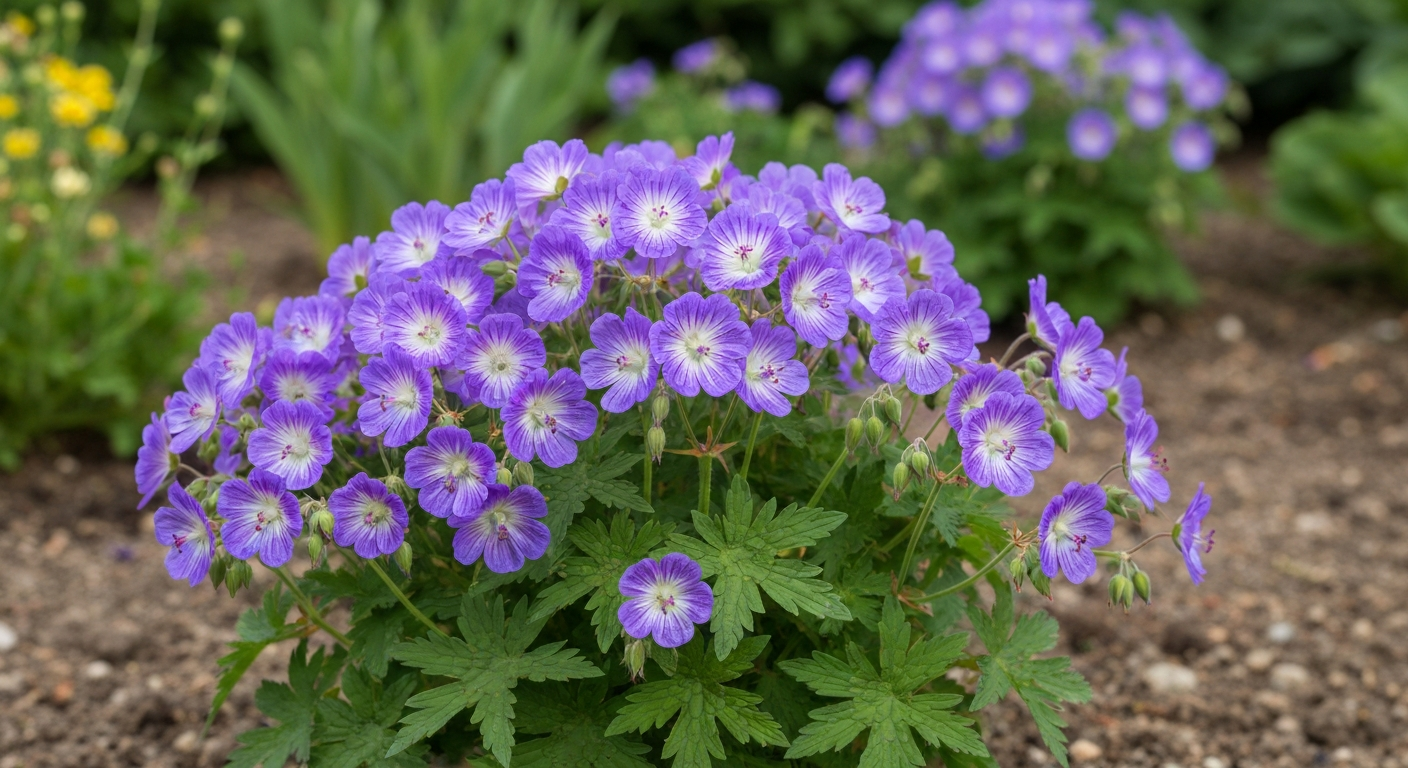
Geranium 'Rozanne' is one of the easiest and most rewarding hardy geraniums you can plant. Give it a well-drained spot with at least four to six hours of sun, work some compost into the soil, plant it at the same depth it sat in its nursery pot, water it well through its first season, and it will reward you with violet-blue flowers from late spring right through the first frosts, often five to six months of near-continuous bloom. It is reliably winter-hardy to USDA Zone 5, needs only light feeding, and comes back stronger every year.
how to grow geranium rozanne: planting, care & seasons guide

Harriet Whitmore
30 Jul 2026
Why Rozanne deserves a spot in your garden
I have grown a lot of cranesbills over the years, and Rozanne stands apart from almost all of them in one specific way: it does not quit. Most hardy geraniums give you a flush of flowers in late spring, look tired by midsummer, and that is that. Rozanne keeps going. It was raised in England by Donald and Rozanne Waterer from a cross between Geranium wallichianum 'Buxton's Variety' and a Geranium himalayense parent, introduced by Blooms of Bressingham, and launched at RHS Chelsea in 2000. By 2013 it had been voted the RHS Chelsea Plant of the Centenary, a recognition it earned partly on that extraordinary bloom season and partly because it just works in so many different garden settings. It holds the RHS Award of Garden Merit, and after growing it myself I would say both awards are well deserved.
Beyond the bloom period, Rozanne is genuinely low-maintenance. It tolerates a range of soil types, recovers well from occasional drought once established, plays nicely with perennials and shrubs, and fills space beautifully as a groundcover or container plant. If you are a beginner who wants a perennial that will not punish you for imperfect conditions, this is a strong first choice. If you are an experienced gardener building a planting scheme, Rozanne is one of those anchoring plants that earns its keep every single season.
Quick facts and bloom timeline
| Attribute | Detail |
|---|---|
| Official cultivar name | Geranium 'Rozanne' (PBR registered as 'Gerwat') |
| Parentage | G. wallichianum 'Buxton's Variety' x G. himalayense |
| Plant type | Hardy herbaceous perennial cranesbill |
| Mature spread | 60–100 cm (24–40 in) depending on conditions |
| Mature height | Approx. 40–50 cm (16–20 in), mounded and trailing habit |
| Bloom season | Late spring/early summer through first frosts (approx. May–October in most temperate zones) |
| Flower color | Violet-blue with a white eye |
| USDA hardiness | Zones 5–8 (cold-hardy to Zone 5 per Michigan State University trials) |
| RHS hardiness | H7 (hardy throughout the UK) |
| Light | Full sun to part shade (4–6+ hours) |
| Soil | Fertile, moisture-retentive, free-draining; pH 5.5–7.5 |
| Awards | RHS Award of Garden Merit; RHS Chelsea Plant of the Centenary 2013 |
In USDA Zone 5 and 6 gardens, Rozanne typically emerges in mid-spring and starts flowering by late May or early June. In Zone 7 and 8 it can begin a few weeks earlier. The peak of flowering hits in early summer, then the plant may slow slightly in the hottest weeks of July or August (particularly in Zone 7 and 8), before rebounding into a strong autumn flush that lasts until hard frosts cut it back. That mid-to-late summer lull is normal, a light trim and a drink of water usually brings it back quickly.
Rozanne versus other plants called 'geranium'
This is worth clearing up before you go any further, because the word 'geranium' covers several completely different plants in common gardening usage, and the care advice for one does not transfer to the others.
Rozanne is a true hardy geranium, a cranesbill in the genus Geranium. It is a frost-hardy perennial that dies back to the ground in winter and regrows from its rootstock every spring. The bedding 'geraniums' most people buy in summer, the ones with big rounded flower heads in red, pink, or salmon, are actually Pelargoniums, a related but distinct genus from South Africa. They are tender plants that will not survive a hard winter outdoors in most of the US or UK. Red geraniums sold as garden bedding plants almost always fall into the Pelargonium group, so if you are also growing those, be aware the watering, feeding, and overwintering guidance is entirely different from what applies to Rozanne. For advice specific to those tender bedding plants, see a guide on how to grow red geraniums (destination c7fc538d-2639-4307-b663-b7d23283189c).
Gerberas are a different plant altogether, a South African daisy (Gerbera jamesonii) with no botanical relationship to cranesbills or pelargoniums. If you want to learn how gerberas grow, see our guide on how do gerberas grow. Jungle geranium (Ixora coccinea) is a tropical shrub from Southeast Asia, again unrelated, and wild geranium (Geranium maculatum) is a North American native woodland cranesbill, closer to Rozanne in genus but adapted to part-shade woodland conditions and a much shorter bloom season. For cultivation details on this tropical shrub, see how to grow jungle geranium (f0af9ace-88c0-44b7-b98a-0aacddeb3e45). For specific guidance on growing wild geranium (Geranium maculatum), see how to grow wild geranium. If any of those sound like what you are looking for instead, those are worth exploring separately. For Rozanne specifically, everything in this guide applies.
Picking the right spot: light, exposure, and microclimate
In cool and temperate climates (roughly Zone 5–6), full sun is ideal, meaning six or more hours of direct light per day. Rozanne flowers most prolifically in those conditions, and the plant stays compact and upright rather than sprawling toward the light. In warmer climates (Zone 7–8), I have found that some afternoon shade makes a real difference. Without it, the foliage can scorch and the plant enters that summer lull earlier and harder. A site that gets morning sun and dappled or open shade from about 2 p.m. onward gives Rozanne in a hot garden much better results than a baking south-facing border.
Avoid frost pockets and low-lying spots where cold air settles in spring, late frosts can catch emerging growth. Similarly, avoid sites with overhead drips from trees or gutters, as prolonged wet on the crown can lead to rot. A slightly raised bed or a gently sloping site both work well because excess water drains away from the crown naturally. Wind exposure is not usually a problem; Rozanne is tough enough to handle a breezy border, but a wind tunnel between buildings can desiccate the foliage quickly in summer.
Preparing your soil before planting
Rozanne is adaptable, it will grow in clay, sandy, or chalky soils, but it performs best in fertile, free-draining loam. The one condition it genuinely dislikes is waterlogged soil. Sitting in standing water over winter is one of the most reliable ways to kill it, so if your soil holds water after heavy rain for more than a day, that needs fixing before you plant.
For heavy clay soils, work in coarse grit or fine horticultural grit (roughly one part grit to three or four parts soil) along with a generous layer of compost, dig the top 20–25 cm (8–10 in) and mix amendments through the whole depth. For sandy soils, the focus is on adding organic matter to improve moisture retention; compost or well-rotted leaf mold both work well. Aim for a soil with around 3–5% organic matter content, which is the level extension soil scientists typically target for productive garden beds. A light top-dressing of compost each spring will maintain that over time without any complicated soil testing.
Rozanne is comfortable across a wide pH range, roughly 5.5 to 7.5, so slightly acidic to slightly alkaline. In most garden soils you will not need to adjust pH specifically for this plant. If you already know your soil is very acidic (below 5.5) or strongly alkaline (above 7.5), a basic soil test from your local extension office is worth doing, but in practice Rozanne rarely shows pH stress in average garden conditions.
Planting Rozanne in the ground
When to plant
In USDA Zones 5 and 6, spring planting after the last hard frost is the standard approach. Wait until the soil is workable and nighttime temperatures are consistently above freezing, late April through May is typical. This gives Rozanne a full growing season to establish before its first winter. In Zones 7 and 8, early autumn planting (September to October) also works well because the soil is still warm enough to encourage root development, and the plant faces less heat stress than a spring transplant. Just make sure it has at least six to eight weeks before the ground freezes so roots can anchor properly.
Step-by-step planting process
- Water the plant in its nursery pot thoroughly an hour or two before planting — a hydrated rootball establishes faster than a dry one.
- Dig a hole about twice the width of the rootball and the same depth. Loosen the base of the hole with a fork so roots can penetrate downward easily.
- Mix a couple of handfuls of compost or well-rotted organic matter into the excavated soil — this is your one-time chance to improve the immediate planting environment.
- Remove the plant from its pot and gently tease apart any circling or matted roots with your fingers. This encourages outward growth rather than roots continuing to circle.
- Set the plant in the hole so the crown (the point where stems meet roots) sits level with the surrounding soil surface. Planting too deep is a common beginner mistake and can lead to crown rot.
- Backfill with your amended soil, firming gently with your hands as you go to eliminate large air pockets — but do not compact the soil heavily.
- Water thoroughly to settle the soil around the roots. Use a slow, steady stream rather than a hard spray that can wash soil away from the crown.
- Space multiple plants 38–75 cm (15–30 in) apart. Use the closer end of that range (15–20 in) for a dense groundcover effect, and the wider spacing (24–36 in) if you want individual plants to develop their full mounded shape.
Growing Rozanne in containers
Rozanne does well in containers, which is useful if your garden soil is problematic or if you want to move it around a patio or terrace. The key differences from in-ground growing are pot size, drainage, and watering frequency, containers dry out faster and can also waterlog faster if drainage is poor.
Pot size and setup
Choose a pot at least 30–35 cm (12–14 in) in diameter for a single plant, Rozanne has a wide spreading habit and will feel cramped in anything smaller within its first season. Larger containers (40 cm / 16 in and above) give even better results and dry out less rapidly. Make sure the pot has drainage holes. If you are using a decorative outer pot without drainage, either drill holes or use the outer pot as a sleeve and keep the plant in a plain inner pot with drainage holes.
Soil mix and drainage layer
Use a good-quality peat-free multipurpose compost mixed with about 20–25% perlite or coarse grit to improve drainage. Straight multipurpose compost tends to compact over time in containers and can become waterlogged. A layer of crocks (broken terracotta pieces) or coarse gravel over the drainage holes prevents the mix from washing out and keeps the holes clear. Avoid placing saucers under outdoor containers unless you empty them after heavy rain, standing water in saucers is a reliable route to root rot.
Container watering setup
Water container-grown Rozanne when the top 2.5–4 cm (1–1.5 in) of compost feels dry. In warm weather this can mean checking every two to three days. For in-ground planting, provide a thorough deep watering at planting and maintain even soil moisture in the first growing season (weekly deep watering in dry spells during establishment is recommended); for containers, check every 2–3 days and water when the top 1–1.5 in (2.5–4 cm) is dry, avoiding standing water in saucers weekly deep watering during establishment and container checks every 2–3 days. When you water, water thoroughly until it runs freely from the drainage holes, then leave it until the surface dries again. The biggest container watering mistakes I see are either shallow surface watering (which leaves the lower rootball dry) or watering on a fixed schedule regardless of what the soil is actually doing. Get in the habit of checking with your finger before watering.
Watering: schedules, techniques, and dealing with extremes
During the first growing season, consistent moisture is important. Rozanne is putting energy into root establishment rather than just flower production, and irregular watering at this stage can set it back considerably. In dry spells, a thorough weekly deep watering (rather than a light daily sprinkle) encourages roots to grow downward toward moisture rather than staying shallow. Shallow roots make plants much more vulnerable to heat and drought stress later on. Michigan State University trial data suggests Rozanne performs well at around 60–80% of reference evapotranspiration in irrigation trials, which in practical terms means keeping the soil evenly moist but not saturated.
Once established (from its second season onward), Rozanne has reasonable drought tolerance. I have seen established plants go two to three weeks without rain during mild dry spells and bounce back without much visible stress. But 'tolerates drought' does not mean 'prefers it', consistent moderate moisture during the growing season, especially in the lead-up to and during peak bloom, produces noticeably better flowering. If you are dealing with a genuine summer drought, a deep soak every ten to fourteen days will sustain the plant far better than a light sprinkling every day.
Waterlogged or heavy wet soils are a more serious problem than dry spells. If your garden holds water after rain, either improve drainage before planting (see soil prep above) or grow Rozanne in raised beds or containers where you control the drainage. Signs of waterlogging include yellowing lower leaves, a general failure to thrive despite watering, and soft, discolored crown tissue. If you catch it early and improve drainage quickly, plants can recover, but if the crown has started to rot, recovery is unlikely.
Feeding Rozanne through the season
Rozanne is not a heavy feeder, and overfeeding, especially with high-nitrogen fertilizers, is a genuine problem I have made myself. Too much nitrogen pushes lush leafy growth at the direct expense of flowers. The plant looks healthy and green but produces far fewer blooms than it should. The best approach for in-ground plants is a single light application of a balanced slow-release granular fertilizer (something like 10-10-10) worked into the soil surface in early spring as growth resumes, or a generous top-dressing of well-rotted compost which releases nutrients slowly through the season.
Container plants need a little more regular feeding because nutrients leach out with watering. A low-dose liquid balanced feed every two to three weeks through the growing season works well, use it at half the rate stated on the label to avoid the nitrogen excess problem. Switch to a lower-nitrogen, higher-potassium feed (like a tomato feed) from midsummer onward to support flowering rather than foliage. Commercial greenhouse production of Rozanne uses a constant feed of around 125 ppm nitrogen, but for home container growers, a conservative slow-release granule at planting plus the occasional liquid top-up is more practical and less risky. Michigan State University notes that commercial greenhouse and plug production of Rozanne commonly uses a constant feed of approximately 125 ppm nitrogen MSU constant feed ≈125 ppm N recommendation.
Pruning and keeping the blooms coming
Rozanne does not need heavy pruning, but a light shearing at the right moments makes a noticeable difference to its overall performance. If the plant looks tired and tangled in midsummer, which can happen in hotter climates, cut it back by about one-third to one-half with a pair of shears or scissors. New growth emerges quickly and brings a fresh flush of flowers within a few weeks. Do not worry about being too precise; Rozanne is forgiving of rough cuts.
Deadheading individual spent flowers is not necessary because Rozanne is largely self-cleaning, but removing old flower stems periodically keeps the plant looking tidy and can extend the bloom season marginally. In autumn, leave the foliage in place until it has died back fully, the dying leaves help protect the crown as temperatures drop. In late autumn or early winter after hard frosts have cut the plant back, clean up the dead material and the crown will be ready to regrow in spring.
Propagating Rozanne
This is where things get slightly complicated. Rozanne was patented in the United States (US Plant Patent PP12175, granted 2001) and holds Plant Breeders' Rights in Europe. The plant is propagated commercially by asexual means, tissue culture and division, and the patent covers those propagation methods during its term. Growing Rozanne from division for personal, non-commercial use in your own garden is generally practiced by home gardeners, but selling or distributing propagated plants is not permitted while intellectual property rights are in force. Worth knowing before you start handing divisions to all your neighbors.
Division
Division is the most practical propagation method for home gardeners and the one that reliably gives you true-to-type plants. Divide established clumps in spring as new growth appears (March to April in most temperate zones) or in early autumn. Lift the whole clump with a fork, gently separate it into sections each with healthy roots and visible growing points, and replant the divisions at the same depth. Water well and keep them consistently moist for the first few weeks. Divisions taken in spring will usually establish and flower in the same season, though perhaps not as prolifically as established plants.
Softwood cuttings
Softwood cuttings taken in late spring (May to June) can work reasonably well. Take a shoot about 8–10 cm (3–4 in) long, remove the lower leaves, dip the cut end in rooting hormone powder, and insert it into a pot of gritty compost or a specialist propagating mix. Keep in a warm, humid environment (a clear plastic bag or propagator lid helps) out of direct sun. Rooting takes three to four weeks. Pot on once roots have developed and grow on before planting out.
Growing from seed
Rozanne seed is not widely available commercially, and there is a specific reason for that: seed-grown plants will not reliably come true to type. Because Rozanne is a cultivar selected from a hybrid cross, its offspring from seed will be genetically variable, you might get something similar, or something quite different. If you find seed labeled as Rozanne, manage your expectations accordingly. For reliable Rozanne plants, buy container-grown specimens from reputable nurseries or propagate from divisions of a known plant.
Companion plants and landscape uses
Rozanne's loose mounding habit and long violet-blue bloom season make it extremely versatile. It works beautifully at the front of a mixed border where it can weave through the base of taller perennials and shrubs. It is one of those plants that looks better tucked between things than standing alone in a formal arrangement.
- Roses: Rozanne's blue-violet flowers complement almost any rose color, and its spreading habit covers bare lower stems elegantly
- Nepeta (catmint): a classic pairing — similar flower color, complementary textures, and both thrive in similar sun-and-drainage conditions
- Alliums: Rozanne fills the gap as allium foliage dies back, transitioning the border seamlessly from spring to summer
- Salvia nemorosa: the upright spikes contrast with Rozanne's sprawling mound and the purple-blue palette is cohesive
- Alchemilla mollis (lady's mantle): the chartreuse flowers of Alchemilla make Rozanne's violet pop in early summer
- Low-growing shrubs like lavender or Caryopteris: Rozanne weaves through their base and extends the blue-toned scheme
- Ground-level use: Rozanne works as a low-maintenance groundcover on gentle slopes or under open-canopy trees with reasonable light
In containers, Rozanne trails attractively over the sides of larger pots and works well in combination plantings with upright thrillers like grasses or Verbena bonariensis. Its long bloom season makes it a reliable 'filler' that keeps combination pots looking good from early summer right through to autumn.
Seasonal care calendar
| Season | Key Tasks |
|---|---|
| Early spring (March–April) | Apply slow-release fertilizer or compost top-dressing; divide established clumps if propagating; check for emerging growth and clear away dead material from autumn |
| Late spring (May) | Plant new container-grown plants after last frost risk; begin regular watering of new plantings; take softwood cuttings if propagating |
| Early summer (June) | Peak bloom period begins; water consistently; monitor for pests; container plants: begin liquid feeding routine |
| Midsummer (July–August) | Lightly shear back if plants look leggy or tired, especially in Zone 7–8; water deeply in dry spells; continue liquid feeding for containers at low rate |
| Early autumn (September–October) | Second flush of flowering; plant new Rozanne in Zones 7–8; reduce feeding; keep watering if dry |
| Late autumn (November) | Leave foliage to protect crown; reduce watering; container plants in Zone 5–6 can be moved to a sheltered spot or unheated greenhouse |
| Winter (December–February) | No active care needed for established in-ground plants; cut back dead foliage when fully browned; check container drainage |
Troubleshooting common problems
Poor or no flowering
The most common culprits are too much shade and too much nitrogen. If your plant is in a shaded spot and producing lots of foliage but few flowers, try moving it or cutting back whatever is casting shade. If you have been feeding heavily with a high-nitrogen fertilizer, reduce or stop and switch to a low-nitrogen, higher-potassium feed. New plantings in their first season also sometimes put most of their energy into root establishment, give them one full season before judging flower production.
Leggy, sprawling growth
Rozanne naturally has a somewhat spreading, trailing habit, but plants that are unusually leggy and flat are usually reaching for light. Check whether surrounding plants or structures are reducing light levels. A light shear in midsummer also helps the plant regenerate with more compact, upright growth for its autumn flush.
Yellowing leaves
Lower leaf yellowing that starts from the base of the plant in the growing season is worth investigating as a drainage or waterlogging issue first. Check that water is not pooling around the crown. If drainage seems fine, it may be a nutrient deficiency (particularly iron or magnesium in very alkaline soils), a soil test will confirm this. Yellowing in autumn as the plant prepares to die back is completely normal and needs no intervention.
Pests
Rozanne is not particularly pest-prone, but vine weevil can be a problem, especially in containers. The adult notches irregular scalloped holes in leaf edges (mostly a cosmetic issue), but it is the larvae feeding on roots over winter that causes real damage. If you notice sudden plant collapse in spring, check the compost for the small creamy-white grubs. Treat with nematodes (Steinernema kraussei applied in autumn while soil is still warm) or with a licensed vine weevil drench. In the open garden, slugs and snails occasionally graze young spring growth, hand-pick at night or use iron phosphate-based pellets around vulnerable new plants.
Powdery mildew
Powdery mildew (a white, dusty coating on leaves) can appear in hot, dry conditions, particularly when plants are under moisture stress or have poor air circulation. Rozanne is less susceptible than some cranesbills, but it is not immune. Improve air circulation by not overcrowding plants, water at the base rather than overhead, and make sure the soil does not dry out completely in summer. If mildew appears, a late-summer shearing will remove the affected foliage and encourage clean regrowth.
Dos and don'ts at a glance
| Do | Don't |
|---|---|
| Plant at the same depth as the nursery pot | Plant the crown deeper than it was growing — crown rot follows |
| Improve drainage in heavy clay before planting | Leave waterlogged soil conditions unaddressed |
| Water deeply and infrequently during establishment | Water shallowly every day — this keeps roots near the surface |
| Give full sun in cool climates (Zone 5–6) | Plant in full sun in hot climates (Zone 7–8) without afternoon shade |
| Use a light balanced fertilizer in spring | Feed with high-nitrogen products — it promotes leaves over flowers |
| Shear back lightly in midsummer if looking tired | Leave a tangled, exhausted plant hoping it recovers on its own |
| Buy named container-grown plants from reputable nurseries | Expect seed-grown plants to be true to type |
| Check containers before watering — finger test the top 2.5 cm | Water on a fixed schedule regardless of actual soil moisture |
Hardiness and climate: what to expect in your zone
Rozanne is reliably winter-hardy to USDA Zone 5, where winter lows can reach around -20°C (-29°F). Michigan State University trial data specifically confirms Zone 5 cold hardiness. In Zone 5, the plant dies back to the ground completely each winter and regrows from the rootstock in spring, this is normal and expected. In Zones 6 and 7 it may retain some basal foliage through mild winters. In Zone 8 it often remains semi-evergreen. In the UK, the RHS rates it H7, hardy throughout all of Britain, including the coldest parts of Scotland.
For Zone 4 gardeners: some sources extend the hardiness claim to Zone 4, but the reliable trial-backed lower limit is Zone 5. You might succeed in a sheltered Zone 4 microsite (against a south-facing wall, under a light mulch), but there is more risk. A thick mulch of straw or dry leaves applied over the crown after the first frosts can improve survival chances by insulating the rootstock against the most extreme cold. Remove the mulch in early spring once frost risk has passed.
In Zone 8 and warmer, Rozanne's main challenge shifts from cold to heat. Summer afternoons above 35°C (95°F) will slow or stop flowering and can cause leaf scorch. Part afternoon shade, consistent moisture, and the midsummer shearing approach will all help carry the plant through until cooler autumn temperatures arrive. Rozanne is not suited to Zone 9 and above in most regions, the heat and humidity of those climates push beyond its comfort range.
Comparing Rozanne to other hardy geraniums
If you are weighing Rozanne against other hardy cranesbills for your garden, the key differentiator is bloom season. Most hardy geraniums are spring-to-early-summer bloomers with a relatively short window. Rozanne's exceptional five-to-six month season is genuinely unusual in the genus. It also has a more trailing, groundcovering habit than many upright cranesbills, which makes it better suited to the front of borders, slopes, and under-planting work.
| Feature | Geranium Rozanne | Typical hardy geranium (e.g., G. x magnificum) | Wild geranium (G. maculatum) |
|---|---|---|---|
| Bloom season | Late spring to first frosts (5–6 months) | 4–6 weeks in late spring/early summer | 4–6 weeks in spring |
| Habit | Mounding, spreading, trailing | Upright to mounding | Upright clump-forming |
| Light preference | Full sun to part shade | Full sun to part shade | Part shade to full shade |
| USDA hardiness | Zones 5–8 | Zones 4–8 depending on species | Zones 3–8 |
| Best use | Groundcover, border front, containers | Mid-border, massed planting | Woodland/naturalized garden |
| Drought tolerance (established) | Moderate | Moderate to good | Good |
Final thoughts
Growing Geranium 'Rozanne' successfully comes down to a handful of non-negotiables: good drainage, appropriate light for your climate zone, consistent watering through the first season, and avoiding the temptation to overfeed. Get those things right and this plant will reward you for years. It is not fussy about soil pH, tolerates a range of soil types once drainage is sorted, and bounces back reliably from the kind of imperfect conditions that come with real gardens. I have seen it thrive in gravel gardens, in large containers on north-facing terraces that catch enough reflected light, weaving through the base of climbing roses, and as a loose groundcover on a sunny bank. Its versatility is part of what earned it that Plant of the Century title. If you have a border spot that needs color from June to October and you want a plant that will largely look after itself once established, Rozanne is close to the ideal answer.
FAQ
What is Geranium 'Rozanne' and are there any naming or patent considerations I should know?
Geranium 'Rozanne' (cultivar identifier 'Gerwat') is a hybrid hardy geranium valued for a very long bloom period. It was protected by plant breeders’ rights and a U.S. plant patent; commercial propagation originally required license until patents expired. For home gardeners, you can buy plants from nurseries or propagate by division or cuttings for personal use.
Which climates and USDA hardiness zones can Rozanne be grown in?
Rozanne is reliably hardy to about USDA Zone 5 and commonly grown in zones 5–8. In cooler climates it tolerates full sun well; in hot climates provide afternoon shade or a cooler microsite to prevent heat stress and foliar decline.
Where should I plant Rozanne (light, soil, drainage, pH)?
Choose a site with full sun to part shade (4–6+ hours daily). Use fertile, moisture-retentive but free-draining soil—loam is ideal. Avoid waterlogged spots; improve heavy clay with compost and coarse grit. Rozanne tolerates a wide pH range (roughly 5.5–7.5).
How do I prepare the planting hole and what is the correct planting depth?
Dig a hole slightly larger than the rootball. Mix native soil with screened compost (aim to improve organic matter toward ~3–5%). Plant at the same depth as in the container so the crown sits level with the soil surface. Tease circling roots gently, backfill, firm lightly, and water thoroughly.
How far apart should I space Rozanne plants?
Space plants 38–75 cm (15–30 in) apart depending on desired density: 15–20 in for tight edging or faster groundcover; 24–36 in (60–90 cm) for a naturalized, mounded planting and good air flow.
When is the best time to plant Rozanne?
Plant in spring after the last hard frost to allow establishment before winter in colder zones. In milder climates you can also plant in early autumn to let roots develop while soils are warm—avoid planting when the soil is frozen or waterlogged.
Next Article
When Do Begonias Start to Grow? Timing, Types & Planting Calendar
When do begonias start to grow: clear planting dates, timelines by type, and quick care fixes for reliable starts.