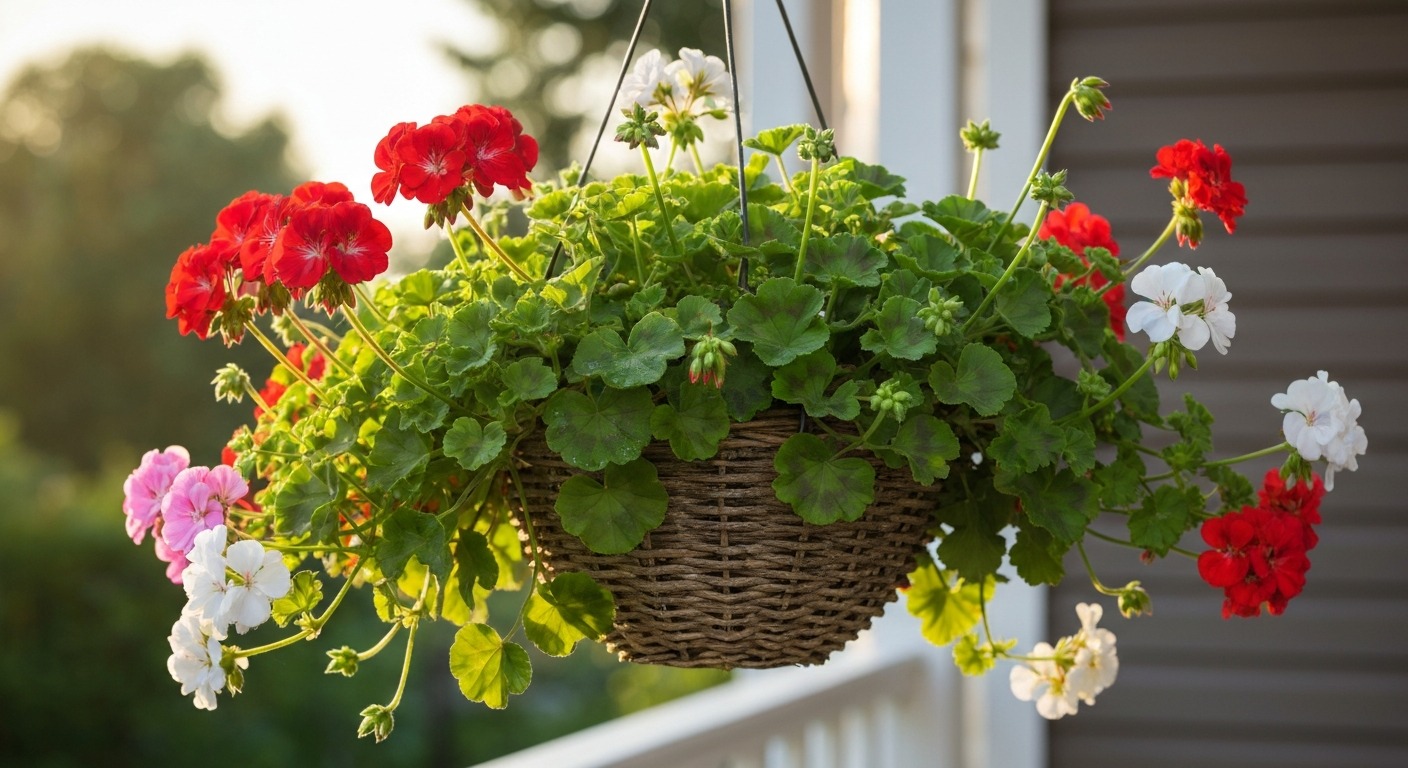
Trailing geraniums (botanically Pelargonium peltatum, the ivy-leaved pelargonium) are some of the most rewarding plants you can put in a hanging basket or window box. Give them well-drained soil, at least four to six hours of sun, consistent watering without waterlogging, and a diluted liquid feed every two weeks during the growing season, and they will cascade 18 to 24 inches of color from late spring right through to the first frost. They're tender perennials hardy only in USDA zones 9 to 11, so in cooler zones you either grow them as annuals or bring them in before frost, but either way, they're absolutely worth the effort.
How to Grow Trailing Geraniums: Complete Care Guide for Baskets & Containers

Harriet Whitmore
6 Aug 2026
Quick-care checklist for trailing geraniums
Keep this list handy when you're setting up your baskets or window boxes. It covers the non-negotiables that separate reliably blooming plants from the disappointing ones.
- Light: Full sun to partial shade (minimum 4 hours, ideally 6 hours of direct sun). In zones 8 and warmer, give afternoon shade to reduce heat stress.
- Water: Keep the growing medium consistently moist but never waterlogged. In hanging baskets, check daily in warm weather as they dry out fast.
- Soil/mix: Free-draining potting mix with added perlite (20–25% by volume). Never use dense garden soil in containers.
- Feeding: Diluted balanced liquid fertilizer (e.g., 10-10-10 or a bloom-booster formula) every 10–14 days during active growth. Reduce to monthly in cooler months.
- Temperature: Plant outdoors only after all frost danger has passed. Ideal growing range is 55–75°F (13–24°C). Bring indoors if temps drop below 40°F (4°C).
- Spacing: Allow 12–14 inches (30–36 cm) between plants in containers. A 10–12 inch basket holds 1–3 plants; a 14–16 inch basket holds 3–5.
- Deadheading/grooming: Remove spent flower stems at the base. Pinch growing tips in early season to encourage branching and a fuller cascade.
- Overwintering (zones 4–8): Bring containers indoors before first frost. Cut back by one-third, keep in a cool bright spot (50–55°F), and water sparingly.
- Pests to watch: Inspect weekly for aphids, spider mites, and whitefly. Treat early with insecticidal soap or neem oil.
- Hardiness zone: True tender perennial, reliably perennial only in zones 9–11. Treat as annual in zones 4–7 or overwinter indoors.
Trailing vs. zonal geraniums: which one do you actually want?
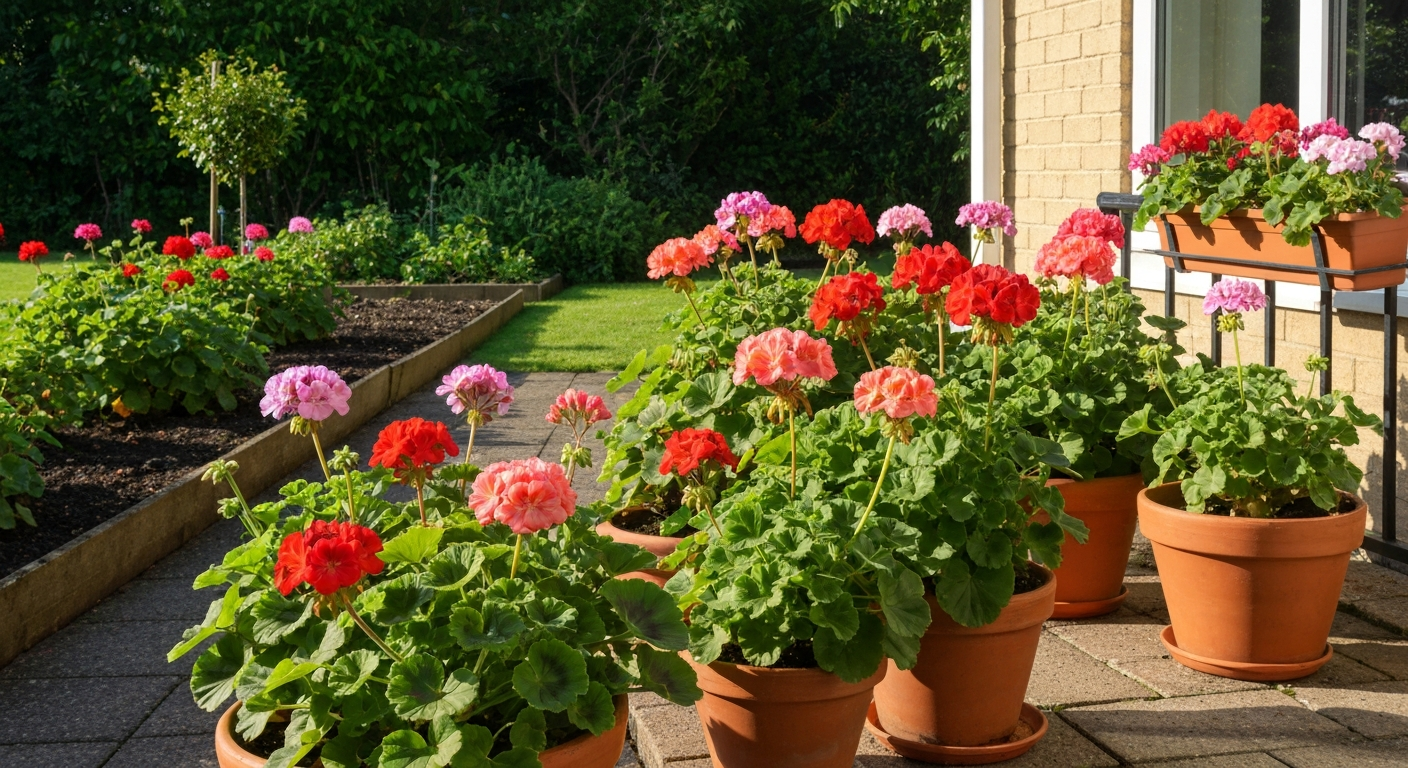
This is the first place beginners go wrong, and it's an easy mistake to make because both are called 'geraniums' at the garden center. Trailing geraniums are Pelargonium peltatum, with fleshy, ivy-shaped leaves and a naturally cascading, spreading habit that makes them ideal for hanging baskets, window boxes, and the edges of raised containers. Zonal geraniums are Pelargonium × hortorum, an upright, mounded plant with distinctive banded leaf markings, better suited to bedding schemes and upright container planting. If you've ever wondered why your 'geranium' basket looked more like a mound than a waterfall, there's a good chance you bought a zonal.
The practical differences go beyond habit. Ivy geraniums tolerate partial shade and handle dry spells better once established in exposed baskets, where the wind accelerates moisture loss. Zonal geraniums need full sun to flower at their best, and they tend to go leggy and stop blooming if the light drops. In very hot climates (zones 8 and above), ivy geraniums actually outperform zonals because they cope better with the combination of bright light and afternoon heat, especially when given some afternoon shade.
There's also a middle ground worth knowing about: interspecific hybrids like the 'Calliope' series cross ivy-leaf habit with the larger flower clusters of zonal types. These give you a semi-trailing plant with big, showy blooms and decent heat tolerance. They're a good pick if you want trailing character but feel that standard ivy geranium flowers look a bit small. That said, if your goal is a dramatic cascading effect in a hanging basket, straight P. peltatum varieties are still the gold standard.
| Feature | Trailing / Ivy (P. peltatum) | Zonal (P. × hortorum) | Interspecific Hybrid (e.g., Calliope) |
|---|---|---|---|
| Habit | Trailing, cascading, spreading to 24" | Upright, mounded | Semi-trailing, compact |
| Leaf shape | Fleshy, ivy-shaped | Rounded with zonal banding | Intermediate |
| Flower size | Small to medium clusters | Medium to large clusters | Large clusters |
| Best use | Hanging baskets, window boxes, container edges | Bedding, upright containers | Hanging baskets, mixed containers |
| Light tolerance | Full sun to partial shade | Full sun preferred | Full sun to partial shade |
| Heat tolerance | Good, especially with afternoon shade | Moderate | Good |
| Shade tolerance | Moderate | Low | Moderate |
| Grow as perennial | Zones 9–11 | Zones 9–11 | Zones 9–11 |
If you're also interested in growing upright types in garden beds, the guide on how to grow zonal geraniums covers that group in much more detail, including variety picks and bedding spacing.
Best trailing geranium varieties by use and climate
Not all trailing geraniums perform the same way in every situation. I've grouped the best-known series and cultivars by where they shine, so you can match the variety to what you're actually trying to do.
For hanging baskets and window boxes
The 'Balcon' series (sometimes sold as 'Balcon Ice Dance', 'Balcon Royale', or under the 'Cascade' umbrella) is arguably the most reliable choice for long, dramatic trails in baskets and window boxes. Plants typically reach 8–10 inches tall with a spread of 14–24 inches and are described as self-cleaning, meaning spent flowers drop on their own rather than sitting on the plant and collecting moisture. Ball Seed culture sheets recommend spacing plants 12–14 inches apart, so a 14-inch basket comfortably holds 3 plants. 'Super Cascade' and 'Sofie Cascade' are similarly well-regarded commercial series with vigorous trailing growth. The RHS Award of Garden Merit cultivars 'L'Élégante', 'La France', and 'Amethyst' are excellent choices if you're looking for tried-and-tested named varieties with documented reliable performance in trials. Dickinson/NDSU cultivar trial reports record comparative performance (vigor, uniformity, flowering) for Pelargonium peltatum and similar bedding-plant trials, useful for validating breeder claims blank" rel="noopener noreferrer">2008 Cultivar Trials of Bedding Plants (NDSU/Dickinson research report).
For seed-starting gardeners
Most trailing geraniums are propagated from cuttings commercially, but if you want to start from seed, the 'Tornado' series and 'Summer Showers' are the two most widely recommended options from university extension sources. Both produce good basket-worthy cascades and are reasonably uniform when started from seed. Just be prepared for longer germination times and a slightly less predictable color range than you'd get from named cutting-propagated varieties.
For hot, dry climates (zones 8–11)
In heat-prone regions, look specifically for series marketed as heat-tolerant. The 'Balcon' types consistently appear on hot-climate recommended lists. Interspecific hybrids like 'Calliope' also hold up well in heat. Critically, in zones 9 and above, site your baskets where they get morning sun and afternoon shade, even heat-tolerant cultivars will drop flower buds and scorch leaves under relentless afternoon sun reflected off walls or paving.
For cool, coastal and temperate climates (zones 6–8)
'L'Élégante' (white flowers with purple-edged, variegated foliage) and 'Amethyst' (lavender-pink double flowers) perform beautifully in the longer, cooler summers typical of coastal regions. Cool nights actually prolong flowering on many cultivars. The classic 'Cascade' types from European balcony gardening traditions, especially pink and red selections, were essentially bred for cool, overcast northern European conditions and thrive in similar North American coastal climates.
For landscape and in-ground planting
In zones 9–11 where trailing geraniums can grow as genuine perennials, vigorous spreading cultivars like 'Cascade' and 'Balcon' types work well as ground cover on slopes or in raised beds with excellent drainage. Keep spacing at 14–18 inches to allow for their natural spread. In these zones, plants can grow substantially larger than their container equivalents, so choose the more vigorous series rather than compact ones.
Picking the right spot: site selection for every growing situation
Trailing geraniums are more adaptable than many people expect, but they do have a non-negotiable requirement: drainage. Whether you're growing them in a basket, a window box, or the ground, water sitting around the roots is the fastest way to kill them.
Hanging baskets
Trailing geraniums were practically made for hanging baskets. They perform best on a south- or west-facing wall or structure that gets at least 4–6 hours of direct sun. Full sun (6 or more hours) produces the most abundant flowering, but in hot climates, a spot with morning sun and afternoon shade is a better call to avoid heat scorch. Avoid sites exposed to constant strong wind: baskets dry out even faster and plants can be physically damaged.
Window boxes
South- and east-facing window boxes are ideal. East-facing spots give morning sun and gentle afternoon light, which suits ivy geraniums well and reduces stress in warmer climates. Ivy Geraniums, Iowa State Extension (site and stress notes) warns that reflected heat from walls or paving, strong winds, or prolonged afternoon sun can cause leaf scorch and reduced bloom, so site ivy geraniums for morning sun with wind protection or partial afternoon shade Ivy Geraniums — Iowa State Extension (site and stress notes). Make sure your window box has drainage holes, never plant into a sealed box without one. Position matters not just for sun but for reflected heat: boxes mounted directly against brick or rendered walls in full afternoon sun can get extremely hot, which stresses roots even if the foliage looks fine.
Large containers and mixed planters
In a large container (14 inches or wider), one or two trailing geranium plants can be combined with an upright 'thriller' plant and other spillers for a classic container combination. Use the same free-draining mix you'd use in a basket. Terra cotta pots dry out faster than plastic or glazed containers and actually suit geraniums well in wetter climates because the extra evaporation through the pot walls reduces the risk of root rot. In dry, hot climates, opt for glazed or plastic to retain moisture longer.
In-ground planting
In zones 9–11, trailing geraniums can be planted directly into the ground as landscape perennials. For broader tips on how to help perennials grow year after year, see how to help perennials grow. For detailed in-ground tips and step-by-step advice, see how to grow geraniums outside. Choose a spot with full sun to part shade and, most critically, excellent drainage. Heavy clay soils must be amended before planting (see the soil mix section below). In zones 6–8, some gardeners plant them in-ground for the summer season and lift the plants in autumn, but container growing is usually simpler for overwintering. The guides on how to grow geraniums in the ground and how to grow geraniums outside go into more detail on in-ground establishment and outdoor bed management.
Planting timeline: one-page quick reference
| Task | When to Do It | Notes |
|---|---|---|
| Start from seed indoors | 8–12 weeks before last frost date | Maintain 65–75°F for germination; expect 14–21 days to sprout |
| Take cuttings from overwintered plants | Late winter to early spring (Feb–Mar in zones 5–7) | 4–6 inch tip cuttings; root in 3–4 weeks at 65°F |
| Purchase nursery plugs/transplants | 4–6 weeks before last frost (to grow on indoors) | Harden off for 7–10 days before moving outside |
| Move plants outdoors / plant in baskets | After last frost, when nights stay above 40°F (4°C) | Don't rush — cold nights stall growth and damage roots |
| First pinch (tip pinching for bushiness) | At planting or when 4–6" tall | Pinch growing tips to encourage branching |
| Begin regular fertilizing | 2–3 weeks after planting, once established | Every 10–14 days with diluted liquid feed |
| Peak bloom season | Late spring through summer into fall | Deadhead regularly to extend display |
| Take cuttings for overwintering stock | Late summer (Aug–Sep), before first frost | Root cuttings to carry plants through winter as compact stock |
| Bring containers indoors (zones 4–8) | Before first frost; when night temps drop to 40–45°F | Cut back by one-third, reduce water, cool bright location |
| Overwinter rest period | Oct–Feb (cooler zones) | Keep at 50–55°F, minimal watering, check for pests monthly |
Seasonal planting calendar by hardiness zone
One of the most common beginner mistakes is planting out too early. Trailing geraniums are genuinely cold-sensitive and a single frost will damage or kill them. Here's how timing breaks down by zone.
| USDA Zone | Last Frost (approx.) | Plant Outdoors | Peak Bloom | Bring Indoors / First Frost | Grow As |
|---|---|---|---|---|---|
| Zone 4 (e.g., Minneapolis) | Mid-May | Late May–early June | July–September | Early September | Annual or overwinter indoors |
| Zone 5 (e.g., Chicago) | Early–mid May | Mid-May to early June | June–October | Mid-October | Annual or overwinter indoors |
| Zone 6 (e.g., St. Louis) | Mid-April | Late April–May | June–October | Late October | Annual or overwinter indoors |
| Zone 7 (e.g., Charlotte NC) | Late March–April | April–early May | May–November | Late November | Annual or overwinter indoors |
| Zone 8 (e.g., Seattle, Dallas) | Late Feb–March | March–April | April–November | December or leave outdoors with protection | Short-lived perennial; overwinter outside with frost cloth |
| Zone 9 (e.g., Los Angeles) | Negligible frost risk | Year-round planting possible | Spring–fall peak; may rest in hottest summer weeks | No need to bring in | Perennial |
| Zone 10–11 (e.g., Miami, Hawaii) | No frost | Any time | Near year-round | No need to bring in | Perennial |
A quick rule of thumb: if you're in zone 7 or colder, treat your trailing geraniums as annuals unless you're committed to overwintering them. The plants don't 'know' they're perennials in your climate, and trying to leave them out over winter in zone 6 will just mean dead plants in spring.
Spring planting (zones 4–7)
Spring is the main planting window in cooler zones. Start seeds or cuttings indoors 8–12 weeks before your last frost date and harden off transplants over 7–10 days before the final move outside. Don't be tempted by a warm spell in early spring, a single hard frost event after planting can wipe out a whole season's worth of work.
Summer planting and succession
In zones 8 and above, you can plant throughout spring and into early summer and still get a full season of bloom. In hot-summer zones, avoid planting in midsummer when the heat combined with transplant stress can knock plants back badly. Late summer planting (August) works well in zones 9–11 for an autumn-into-winter display.
Fall and overwintering prep (all zones)
In zones 4–8, autumn is the time to either take cuttings (late August to early September) or prepare whole plants for overwintering indoors. Don't wait for frost, the transition to indoor conditions is smoother when done while temperatures are still mild. In zones 9–11, fall is actually an excellent secondary planting window because cooler nights improve flower color and plant vigor.
Step-by-step planting and establishment
Once you have your plants, the potting-up process is straightforward if you follow the right sequence. Rushing any of these steps is where problems usually start.
- Choose your container: Make sure it has drainage holes. For a hanging basket, 10–12 inches works for 1–3 plants; 14–16 inches for 3–5 plants. For window boxes, plan on one plant every 12–14 inches of length.
- Prepare your mix: Use a free-draining potting mix (see the soil recipe section below). Fill the container to about 2 inches below the rim to leave watering room.
- Water before planting: Moisten the mix until water runs freely from the drainage holes. Planting into dry mix stresses roots.
- Remove plants from their nursery pots: Gently tease apart any circling roots at the base of the root ball. This encourages outward root growth into the new mix.
- Space correctly: Place plants at the recommended 12–14 inch spacing. For a basket, angle outer plants slightly toward the rim so their stems naturally trail downward from the start.
- Firm in and water: Press the mix gently around each root ball to eliminate air pockets, then water again. The mix will settle; top up if needed.
- Pinch growing tips: If plants are leggy or have one main stem, pinch out the growing tip just above a leaf node. This feels counterintuitive but it stimulates branching and a fuller, more cascading plant.
- Position in your chosen site: Place in final position immediately after planting. For the first week, keep baskets in a slightly sheltered spot to reduce transplant stress before moving to their full-sun position.
- Begin feeding 2–3 weeks after planting: Once you see new growth, the plant is established and ready for its first feed. Starting fertilizer too early on stressed transplants can burn roots.
From first planting to first bloom
From a nursery transplant or established plug, expect the first flush of proper bloom 3–5 weeks after planting under good conditions. Plants started from seed take longer, typically 12–16 weeks from germination to first bloom, which is why the 8–12 week indoor start window is important. Don't panic if a newly planted basket looks sparse for the first few weeks. Trailing geraniums put energy into root establishment first, and then the top growth and flowering follow quickly once the roots are settled.
Container and soil mix recipes
The single biggest mistake I see with geraniums in containers is using regular garden soil or a heavy, peat-dense potting mix without any amendment. Both stay wet too long and invite the root rot that kills more trailing geraniums than anything else. Here are three tested recipes for different situations.
Recipe 1: Standard hanging basket and window box mix
- 60% high-quality peat-free or peat-based potting compost (a loam-based mix like John Innes No. 2 works well if available)
- 25% perlite (improves drainage and aeration, prevents compaction)
- 10% coarse horticultural grit or fine bark (adds structure and further improves drainage)
- 5% slow-release granular fertilizer (e.g., a balanced 14-14-14 formulation) worked into the mix at planting
Why this works: the perlite keeps the mix open so water drains quickly past the root zone rather than sitting around it. The slow-release fertilizer provides background nutrition for 3–4 months so you can focus your liquid feeding on boosting bloom rather than correcting deficiencies. In hanging baskets exposed to wind and sun, this mix will need watering daily in hot weather, which is fine, because it drains freely and won't become waterlogged.
Recipe 2: Large container mix (14 inches or wider)
- 50% potting compost
- 20% perlite
- 20% loam or topsoil (adds weight to stabilize larger containers and improves water retention slightly)
- 10% coarse grit or composted bark
- Slow-release fertilizer at the manufacturer's recommended rate
The addition of loam in larger containers helps buffer moisture in the greater volume of mix, meaning the plant isn't as dependent on daily watering. It also adds weight, which matters for tall baskets or containers on balconies in windy spots.
Recipe 3: In-ground soil amendment (zones 9–11)
- Native soil: assess drainage first — if water pools for more than 30 minutes after heavy rain, the drainage is too poor without amendment
- Incorporate 3–4 inches of coarse horticultural grit or sharp sand into the top 12 inches of soil (to open up heavy clay)
- Add 2–3 inches of well-rotted garden compost or aged bark fines to improve soil structure and water retention in sandy soils
- For heavy clay sites, consider raising the planting area by 4–6 inches using an amended mound or low raised bed
In-ground trailing geraniums in zones 9–11 are more forgiving about soil than containerized plants, because the greater soil volume buffers both moisture and temperature. But drainage is still the priority, Pelargonium peltatum roots in saturated soil will rot regardless of how warm the climate is.
Light, water, and feeding through the season
Getting the light right
Full sun means at least 6 hours of direct sunlight. Partial shade means 3–6 hours. Trailing geraniums are comfortable in either, but the fewer hours of sun they get, the fewer flowers you'll see. In my experience, 5–6 hours is the sweet spot that balances good flowering with manageable water demands. In zone 7 and cooler, aim for as much sun as you can give them. In zone 8 and above, protect them from harsh afternoon sun (especially between 2pm and 5pm) to avoid leaf scorch and bud drop. South-facing and west-facing sites work well in cooler zones; east-facing sites with a wind break are the safer choice in hot climates.
Watering without overwatering
Trailing geraniums are more drought-tolerant than many basket plants, but 'drought-tolerant' doesn't mean 'ignore.' In a hanging basket in full summer heat, you may need to water once or even twice daily. The test is simple: push your finger about an inch into the mix, and if it's dry at that depth, water thoroughly until it runs from the drainage holes. In cooler, wetter periods, you may only need to water every 2–3 days. The key is consistency: irregular watering (soaking then letting it dry completely, repeatedly) stresses plants and reduces bloom. If you're going away for more than a couple of days in summer, self-watering baskets or a drip irrigation system makes a real difference.
Feeding for continuous bloom
Trailing geraniums are moderate feeders. A balanced liquid fertilizer (10-10-10 or similar) applied every 10–14 days during active growth keeps plants flowering consistently. Some gardeners switch to a higher-potassium formula (such as a tomato feed with a higher third number, e.g., 4-6-8) once plants are established and blooming, to push flower production. Both approaches work. What doesn't work is feeding heavily with a high-nitrogen formula throughout the season, you'll get lush, dark green foliage and disappointing flower numbers. If you used a slow-release granular fertilizer in your mix at planting, you can reduce liquid feeding to every three weeks for the first couple of months.
Deadheading, pinching, and keeping plants tidy
Most modern trailing geranium series, including the Balcon types, are described as 'self-cleaning,' meaning spent flower heads drop on their own. That's a real selling point, but even self-cleaning varieties benefit from a quick check once a week. Remove any flower stems that haven't dropped cleanly, especially in wet weather, because sitting spent flowers can harbor botrytis (grey mould). For older cultivars or any variety that holds onto its spent blooms, deadheading by snapping or cutting the whole flower stem back to the base (not just the dead flower head) keeps the plant tidy and redirects energy to new buds.
Pinching is different from deadheading. In early season, at planting or when plants are 4–6 inches tall, pinching out the soft growing tip of each stem by about half an inch forces the plant to produce side shoots, making the cascade fuller and denser. It delays the first flowers by a week or two, but the result is a noticeably better plant for the rest of the season. It's worth doing.
Propagating trailing geraniums: cuttings and seed
Taking cuttings (the best method)
Cuttings are by far the most reliable way to propagate trailing geraniums, and they're genuinely straightforward. The ideal time is late summer (August to early September) before the first frost, using material from healthy, actively growing plants.
- Select a healthy, non-flowering stem tip 4–6 inches long. If the stem has flower buds, remove them — you want the plant's energy going into root production, not blooming.
- Use a clean, sharp knife or scissors and cut just below a leaf node (the point where a leaf attaches to the stem).
- Remove the lower leaves, leaving 2–3 leaves at the top of the cutting.
- Allow the cut end to dry and callous over for 30–60 minutes in open air. This step significantly reduces the risk of rot during rooting — don't skip it.
- Insert the cutting about 1–1.5 inches deep into a small pot of free-draining cutting compost (50% perlite and 50% multipurpose compost works well). Do not use rooting hormone — geranium cuttings root readily without it.
- Water lightly, then allow the mix to dry slightly between waterings. Keep at 60–65°F (15–18°C) in a bright spot out of direct sun.
- Check for rooting after 3–4 weeks by gently tugging — if there's resistance, roots have formed. Pot on into a larger container once the roots fill the small pot.
Growing from seed
Starting trailing geraniums from seed requires more patience but is a satisfying option if you want large quantities of plants inexpensively. Use the 'Tornado' or 'Summer Showers' series for the best results from seed. Sow 8–12 weeks before your last frost date into a fine seed-starting mix, barely covering the seeds (they need light to germinate well). Keep at 65–75°F, a heat mat helps. Germination takes 14–21 days, sometimes longer. Once seedlings have their first true leaves, prick out into individual small pots. The critical thing with seed-started geraniums is patience: they take 12–16 weeks from germination to first bloom, so early, accurate timing matters.
Overwintering: keeping plants alive between seasons
In zones 4–8, trailing geraniums will die if left outside through winter, but they're easy to keep alive indoors. The simplest approach is to take cuttings in late summer (see above), root them, and carry compact young plants through the winter on a cool, bright windowsill. These cuttings will be vigorous, pest-free plants ready to go out the following spring. Alternatively, bring the whole container indoors before the first frost.
If overwintering whole plants: cut them back by about one-third to reduce the demand on roots during the low-light months, move them to a cool (50–55°F / 10–13°C), bright location, a cool bedroom, frost-free greenhouse, or garage with a south-facing window all work. Water very sparingly: once every 2–3 weeks is usually enough. The plants will look sad and semi-dormant through the dark months, but they're alive. In late winter (February in most temperate zones), move them to warmer, brighter conditions, increase watering, and give them a diluted feed. New growth will appear within a couple of weeks.
One thing I've learned through experience: check overwintering plants monthly for pests, especially whitefly. Indoor conditions are perfect for whitefly populations to explode on geraniums, and a modest infestation in November becomes a serious problem by February if you don't catch it early.
Troubleshooting common problems
Most trailing geranium problems trace back to one of four root causes: too much water, too little light, wrong temperature, or a pest that's been ignored too long. The table below covers the most common symptoms and what to do about them.
| Symptom | Most Likely Cause | What To Do |
|---|---|---|
| Yellowing lower leaves | Overwatering or waterlogged roots | Check drainage holes are clear; reduce watering frequency; repot into drier free-draining mix if root rot is present |
| Leggy stems, sparse flowers | Insufficient light | Move to a brighter spot with at least 4–6 hours direct sun; pinch stems to encourage bushier growth |
| Leaf scorch (brown edges/patches) | Reflected heat or too much afternoon sun in hot climates | Move basket to morning sun/afternoon shade; check for drought stress alongside heat exposure |
| Bud drop without opening | Heat stress, drought, or sudden temperature change | Ensure consistent moisture; site away from afternoon heat; avoid moving plants frequently |
| Powdery white coating on leaves | Powdery mildew (fungal) | Improve air circulation; avoid overhead watering; apply a diluted baking soda spray or sulfur-based fungicide |
| Grey fuzzy mould on stems or spent flowers | Botrytis (grey mould), usually in cool wet conditions | Remove affected material immediately; improve ventilation; avoid wetting foliage; space plants better |
| Distorted, sticky new growth | Aphid infestation | Treat promptly with insecticidal soap or neem oil; check the undersides of leaves and growing tips |
| Fine webbing on leaf undersides, pale stippling | Spider mites (common in hot, dry conditions) | Increase humidity around plants; spray undersides with water; treat with neem oil or a miticide if persistent |
| White powdery insects on leaf undersides | Whitefly | Yellow sticky traps for monitoring; treat with insecticidal soap; particularly common on overwintering plants indoors |
| No flowers despite healthy foliage | Too much nitrogen fertilizer, or insufficient light | Switch to a lower-nitrogen, higher-potassium feed; ensure adequate light; check if plant is newly established (normal for 3–5 weeks post-planting) |
| Black, mushy stems at the base | Blackleg (bacterial/fungal stem rot) | Remove and discard affected plants; do not reuse the mix; improve drainage; avoid overwatering |
| Rust-colored spots on leaf undersides | Pelargonium rust (fungal) | Remove affected leaves promptly; avoid wetting foliage; treat with a copper-based fungicide; improve air circulation |
A few final thoughts from experience
Trailing geraniums are forgiving plants once you understand their priorities: drainage over water retention, consistent feeding over sporadic heavy doses, and enough light to justify all the flowering they're capable of. The most common failures I've seen, and made myself, come down to overwatering a mix that can't drain fast enough and planting out before the cold nights are really done. Get those two things right and you'll find that trailing geraniums are among the most reliably rewarding container plants you can grow. Whether you're filling a 10-inch basket on a balcony or cascading plants over the edge of a raised bed in a frost-free garden, the approach is the same: respect the drainage, feed consistently, and give them the sun they need. The rest more or less takes care of itself.
FAQ
What are trailing (ivy/cascading) geraniums and how do they differ from zonal geraniums?
Trailing geraniums (Pelargonium peltatum and interspecific trailing hybrids) have a trailing or cascading habit, fleshy ivy‑shaped leaves and are bred for hanging baskets, window boxes and edging. Zonal geraniums (Pelargonium × hortorum) are mounded/erect, often have zoned leaf markings and are used as bedding or container plants. Ivy types tolerate light shade and dry spells better in exposed baskets; zonals typically need more full sun to produce abundant blooms.
Which trailing geranium varieties are best for containers, hanging baskets and hot or cool climates?
For hanging baskets/window boxes choose series bred for trailing habit and vigor: Balcon, Cascade/Super Cascade, Tornado (seed options) and Sofie/Cascade. Interspecifics such as Calliope give larger flowers with semi‑trailing habit. For hot climates pick heat‑tolerant series (Balcon, some Cascade lines); in cooler coastal climates choose vigorous, reliably flowering cultivars (many Balcon/Calliope lines trial well). Select compact vs. vigorous cultivars based on basket size and desired spill.
When should I plant trailing geraniums by hardiness zone?
Start cuttings or seeds indoors 8–12 weeks before your last frost date. Plant nursery transplants outdoors only after all risk of frost has passed. Treat pelargoniums as tender perennials in USDA zones ~9–11 (can be left outdoors); in zones 4–8 grow as annuals or overwinter indoors as potted plants. In zones 8–9 you can move pots under cover or into bright, cool indoor space for winter.
What size containers and how many plants per hanging basket or window box?
Use 10"–12" baskets for 1–3 trailing geraniums, and 14"–16" baskets for 3–5 plants, depending on vigor and desired fullness. Use the cultivar spacing (commonly 12–14"/30–36cm mature spacing) to plan numbers. Provide good drainage and avoid oversized pots that hold excess water.
What is the ideal potting mix or soil recipe for trailing geraniums?
Use a free‑draining, airy mix: 40% high‑quality professional peat‑or coir‑based potting mix, 30% coarse perlite or pumice for drainage, 20% compost or well‑aged bark for nutrients and structure, 10% coarse sand or grit to improve drainage. For in‑ground planting amend heavy soils with compost and grit to improve drainage; geraniums dislike waterlogged roots.
How much light, temperature and watering do trailing geraniums need?
Light: full sun (≥6 hours) for best flowering, but in hot regions prefer morning sun and afternoon shade. Partial shade (3–6 hours) is acceptable and reduces stress. Temperature: optimal daytime 65–75°F (18–24°C), nights 50–60°F (10–16°C). Watering: water when top 1–2" (2.5–5 cm) of soil is dry—keep evenly moist but never waterlogged; baskets dry faster so check more often. Avoid prolonged drought or constant saturation.
Next Article
How to Grow Zonal Geraniums: Complete Care Guide from Seed to Bloom
Complete step-by-step guide to growing zonal geraniums: seed to blooms, planting, care, pests, and overwintering.