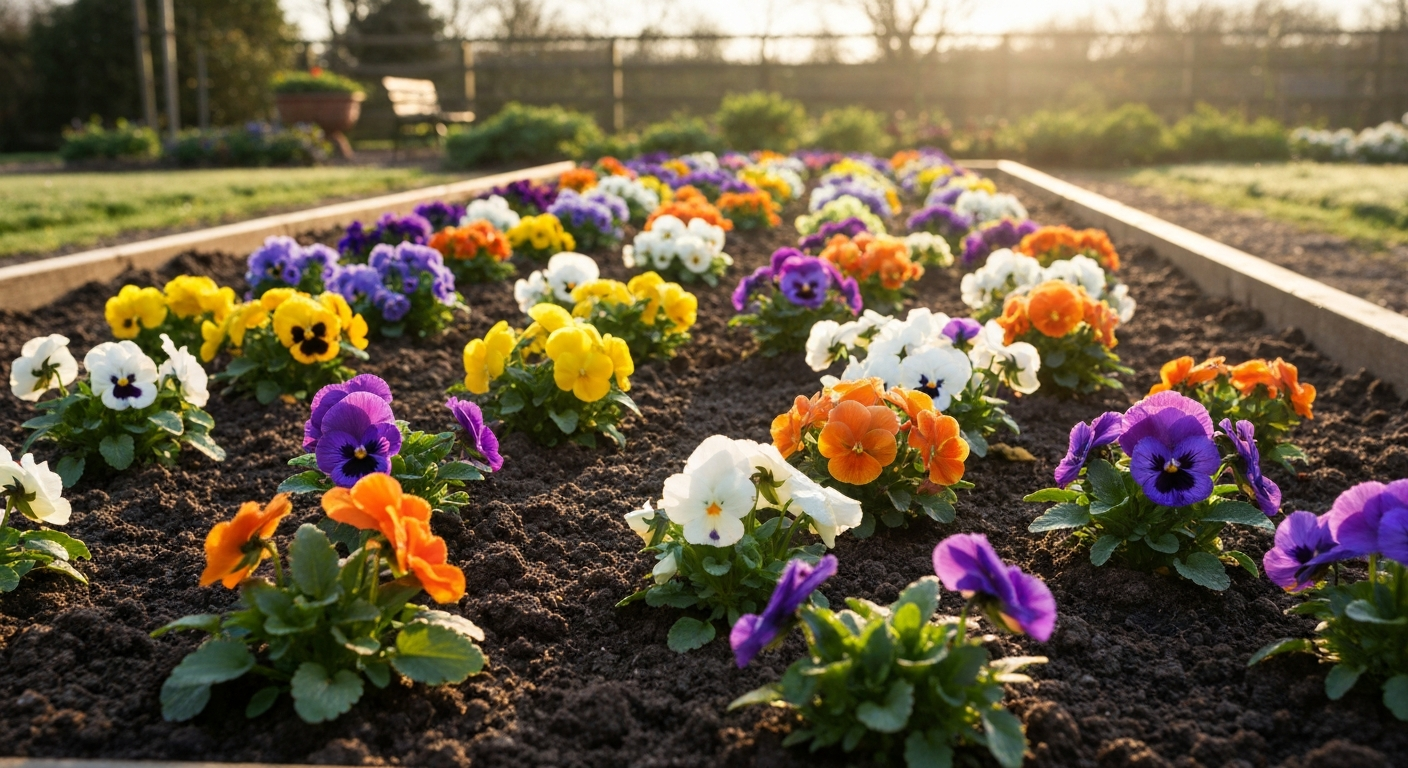
Pansies can bloom through summer, but they need real help to do it. These are cool-season plants that genuinely struggle when daytime temperatures push past 30°C (86°F), and research backs that up: controlled trials found that sustained heat near that threshold reduced total flower number and area by 60 to 88% compared to plants grown at a comfortable 20°C (68°F). So the honest answer is that you're not going to get lush, nonstop color from pansies the way you do in spring, but with the right microclimate, some shade, consistent water, and heat-tolerant varieties, you can extend their season meaningfully or keep containers blooming through warm spells in cooler regions.
How to Grow Pansies in the Summer: Heat-Proof Planting Guide

Harriet Whitmore
13 Aug 2026
Why summer is so hard on pansies
Viola × wittrockiana, the species behind most garden pansies, evolved for cool, temperate conditions. Once night temperatures climb above roughly 18°C (65°F) and days regularly hit 30°C (86°F) or above, the plant shifts its energy away from flowering. You'll see the symptoms quickly: flowers shrink, buds drop before opening, stems get leggy and start flopping, and leaf edges may scorch. University extension programs in Iowa, Utah, and California all describe pansies as cool-season plants that commonly need to be removed or replaced once peak summer heat arrives in warm climates. That's not a failure on your part; it's just the plant's biology.
That said, gardeners in cooler climates, USDA zones 3 through 6, often get a full summer season from pansies without much drama, especially at elevation or in naturally shaded spots. Gardeners in zones 7 and above face a tougher fight. The strategies below are organized around that reality: some are about extending the season as long as possible, others are about setting up conditions where pansies can genuinely thrive rather than just survive.
The summer-ready strategy: what actually makes a difference
I've found that gardeners who succeed with summer pansies are usually doing several things at once rather than relying on one fix. The core principles are: put the plants in a cooler microclimate, limit direct afternoon sun, keep root-zone moisture and temperature stable with mulch and smart irrigation, choose varieties bred for warm-weather persistence, and stay on top of deadheading so the plant keeps trying to flower. None of these are complicated, but skipping one tends to undo the others. Let's go through each one. For a concise checklist of basic requirements, see what do pansies need to grow.
Picking the right spot: site selection and microclimates
This is honestly the biggest lever you have in summer. Pansies described as 'full sun to part shade' plants are giving you that range for spring and fall; in summer, part shade is not optional in most of the country, it's essential. Look for spots that get direct sun in the morning, roughly before 11 a.m., and then shift into dappled or full shade for the hottest part of the afternoon. East-facing beds and the north side of a fence, wall, or taller shrub are natural candidates.
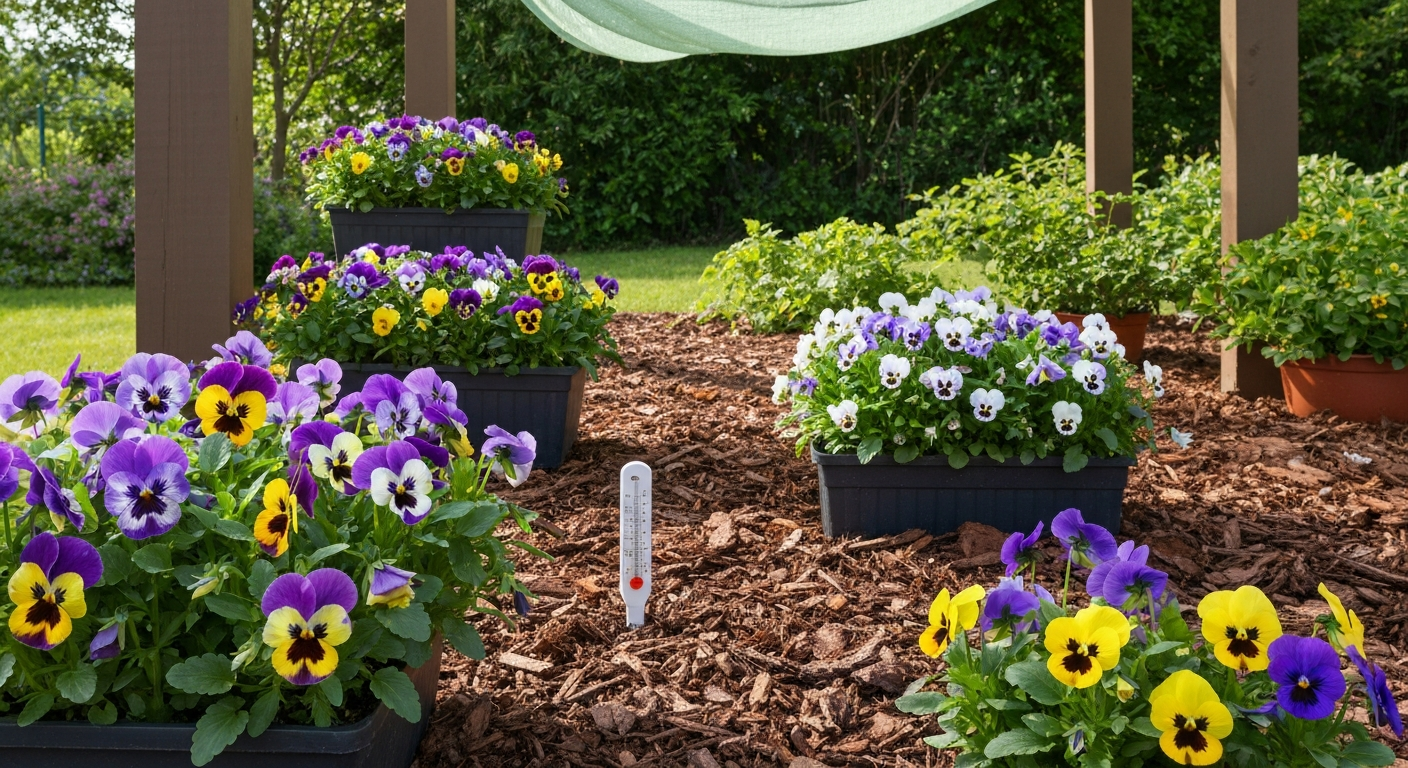
Microclimates matter more than most gardeners realize. A paved patio reflects heat upward onto nearby plants. Dark mulch or bare soil absorbs and re-radiates heat at root level. Raised beds warm faster than in-ground beds, which can be an advantage in spring but a disadvantage in July. If you're growing pansies outside in beds, reading the temperature story of your specific garden space, not just the regional forecast, makes a real difference. Stick a thermometer at plant level on a hot afternoon; you might be surprised how much a few feet of distance from a concrete path changes the reading.
For container growers, placement flexibility is a major advantage. You can move pots as the season progresses. I usually start my pansy containers in full morning sun in late spring, then shift them to a shadier spot under a pergola or near a north-facing wall once temperatures consistently top 27°C (80°F). That simple adjustment has extended my blooms by several weeks compared to leaving them in place.
Shade solutions: cloth, structures, and timing
When natural shade isn't available, shade cloth is a practical and affordable solution. Research on protected cropping in warm climates shows that shade nets can lower ambient air temperature underneath them by 1 to 5°C (roughly 2 to 9°F) depending on net density, color, and how they're installed. For pansies, a 20 to 30% shade cloth used during the peak heat window, roughly noon to 4 p.m. local solar time, gives meaningful temperature relief without cutting so much light that the plants get floppy and fail to flower.
Heavier shade cloth (40 to 50%) provides more temperature reduction but comes with trade-offs: reduced light means fewer flowers, and the lower airflow under denser fabric can raise humidity and increase the risk of fungal disease. My preference is to go lighter on the shade cloth and use it only during the hottest part of the day, removing it in the evening so plants get good airflow overnight. You can drape it loosely over hoops above a bed or attach it temporarily to a fence or trellis.
- Use 20–30% shade cloth for afternoon protection in zones 6–7; go up to 40–50% only in zones 8 and above
- Deploy shade during peak heat hours (roughly noon to 4 p.m.) and remove or open the cloth in the evenings
- Avoid enclosing plants fully with shade fabric, which traps humidity and invites botrytis and downy mildew
- Tall companion plants, trellised climbers, or ornamental grasses planted to the southwest of a pansy bed provide effective living shade
- White or silver shade cloth reflects more heat than black; either works, but lighter colors run slightly cooler underneath
Soil preparation: texture, pH, drainage, and organic matter
Pansies want a soil pH in the range of 6.0 to 7.0, slightly acidic to neutral. Below about pH 5.5, nutrient availability drops off and plants struggle even when everything else looks right. I test new beds with a basic home kit before planting; it takes five minutes and has saved me a lot of head-scratching. If your soil is too acidic, ground limestone raises pH; if it's too alkaline, sulfur lowers it, though significant pH shifts take weeks to fully register.
Drainage is equally important. Pansies don't tolerate waterlogged roots, particularly in summer when warm, wet soil is a fast route to root rot. The standard amendment approach that works well is to work 2 to 4 inches of well-composted organic matter into the top 6 to 8 inches of the bed. This does two things at once: it opens up heavy clay soils to improve drainage, and it adds water-holding capacity to sandy soils that dry out too fast in summer heat. Aim for roughly 10 to 20% organic matter by volume in your planting zone.
For containers, use a quality potting mix rather than garden soil, which compacts and loses drainage quickly in pots. A mix with perlite or coarse bark included is ideal. Avoid anything labeled as 'moisture control' or heavily amended with water-retaining crystals for summer pansy containers; in hot weather, those mixes can stay too wet at the root zone overnight, which is when rot sets in. A well-draining mix that you water frequently is safer than a dense mix you water less often.
Mulching: your best tool against summer soil heat
A layer of organic mulch over your pansy beds does more work than almost any other single technique in summer. It insulates the root zone against temperature swings, slows evaporative water loss, and keeps the soil surface from forming a crust that blocks water from penetrating. University of Minnesota Extension recommends 2 to 3 inches of organic mulch for beds, and that guidance holds well for pansies. I use shredded hardwood bark or straw, both of which break down over the season and add a little organic matter back into the soil.
One thing to avoid: rock mulch, gravel, and rubber mulch all absorb and re-radiate heat, which is exactly what you don't want around cool-season plants in summer. Stick with light-colored organic options. Keep mulch pulled back an inch or two from plant stems to avoid creating a humid collar that encourages crown rot. In containers, a thin layer of pea gravel or bark on top of the potting mix helps moderate surface temperature and slow moisture loss from the top of the pot.
Watering pansies in summer: schedules, techniques, and tips
Summer irrigation is where a lot of pansy failures happen, and the error usually goes in one of two directions: either the plants dry out between waterings because summer heat demands more frequent irrigation than spring did, or they stay too wet because gardeners water on a fixed schedule without checking what the soil actually needs. Both cause problems.
For in-ground beds with mulch, a common benchmark for ornamentals is about 1 inch of water per week, from rain plus irrigation combined. In practice, summer heat and wind will often push that higher, and sandy soils will need more frequent, lighter applications than clay-heavy soils. The real guide is the soil itself: check moisture at 2 to 3 inches depth before watering. If it's still damp, wait. If it's dry, water thoroughly.
Containers need much more attention. In hot weather, small to medium pots can dry out completely within 24 hours, and on a 35°C (95°F) day with wind, sometimes faster. Check containers daily and water when the top inch or two is dry. Water until you see it drain freely from the bottom, which ensures you've wet the full root ball rather than just the surface. Drip emitters or spray stakes sized to the container volume are worth setting up if you have more than a handful of pots; they deliver water to the root zone, reduce foliar wetting that can lead to disease, and free you from daily hand-watering.
Timing your watering matters too. Water in the morning when possible, so foliage can dry before nightfall. Wet leaves going into a warm night are an invitation for fungal issues like botrytis. Avoid overhead watering if you can; drip irrigation or a watering wand aimed at the soil surface keeps the leaves dry and is more water-efficient. If you're hand-watering a bed, a gentle wand attachment aimed low works better than a sprinkler arc.
Heat-tolerant varieties worth planting
Not all pansies respond to heat the same way, and research confirms that cultivar-by-temperature interactions are significant. Some series have been specifically bred or selected for improved performance in warmer conditions and show up repeatedly in commercial trial summaries and extension trial gardens. The Matrix series from PanAmerican Seed is probably the most widely cited for summer persistence; the Universal series and the trailing Cool Wave and Plentifall types are also frequently recommended. That said, no pansy is truly heat-proof, and even these varieties will flag when sustained temperatures stay near 30°C for extended periods.
Violas (Viola cornuta), which are closely related but smaller-flowered, tend to handle heat better than large-flowered pansies and are worth considering for summer color in warmer zones. They're less dramatic in terms of flower size but more persistent and often re-bloom more readily after cutting back.
Planting timing by climate zone
If your goal is to have pansies blooming through summer rather than just surviving it, timing your planting and choosing your zone honestly is the most practical starting point. In cooler zones (3 to 5), you can plant transplants in mid to late spring after frost risk passes and expect blooms well into summer, often until August or September. In zones 6 and 7, an early spring planting (late March to mid-April) gives you spring through early summer color before heat forces decline. In zones 8 and above, summer pansies are genuinely difficult; these regions are better served by fall plantings that carry through winter, which is actually when pansies thrive in the South and in mild coastal climates.
| USDA Zone | Best Planting Window for Summer Color | Realistic Bloom Duration | Key Strategy |
|---|---|---|---|
| 3–5 | Mid-April to late May | May through August–September | Full sun acceptable; standard care |
| 6 | Late March to mid-April | April through late June–July | Afternoon shade after June; deadhead consistently |
| 7 | Early to mid-March | March through May–June | Heavy shade cloth, heat-tolerant varieties, mulch |
| 8–9 | Not recommended for summer; plant Sep–Oct | Oct through April (winter bloomer) | Replant in fall; remove in May |
| 10–11 | October to November | November through March | Cool-season only; no summer viability |
Planting step by step: beds and containers
In-ground or raised beds
- Test and amend soil pH to 6.0–7.0 before planting; work in 2–4 inches of compost to the top 6–8 inches
- Choose a site with morning sun and afternoon shade, or prepare to install shade cloth
- Space transplants 6 to 8 inches apart; crowding increases humidity and disease risk
- Set transplants at the same depth they were in their nursery cell; do not bury the crown
- Water in thoroughly at planting to settle the soil around roots
- Apply 2–3 inches of shredded hardwood mulch over the bed, keeping it clear of stems
- Deadhead spent flowers every few days to prevent seed set and encourage reblooming
- Pinch back leggy stems by one third if plants start stretching; this triggers new branching and buds
Containers
- Use a well-draining potting mix with perlite; fill container to within 1 inch of the rim
- Incorporate a slow-release granular fertilizer at the rate on the product label before planting
- Plant transplants at the same depth as in their nursery cell; firm gently and water in
- Place containers where they receive morning sun and midday to afternoon shade in summer
- Check soil moisture daily in warm weather; water when the top 1–2 inches are dry
- Move containers to shadier spots or indoors if temperatures stay above 32°C (90°F) for more than a day or two
- Deadhead regularly and fertilize with water-soluble fertilizer every 1–2 weeks throughout summer
Succession planting and keeping the season going
One strategy I've found genuinely useful is succession planting: starting fresh transplants every four to six weeks in spring so that as the first planting fatigues in early summer heat, a second, younger flush of plants is ready to take over. It's more work than planting once and hoping for the best, but in zones 6 and 7 it meaningfully extends pansy color into summer. Start the succession plants in a cool, partly shaded nursery spot while the first batch is still blooming, then transplant them into prepared spots as the first group declines.
When your summer pansies finally give up, that's a good moment to think about what comes next. Many gardeners transition beds directly to heat-loving summer annuals like zinnias, marigolds, or celosias. Then in early September, it's worth revisiting pansies for a fall planting, which in most of zones 6 through 8 will carry color well into November or even through a mild winter.
Fertilizing summer pansies
Pansies are moderate feeders; they don't need heavy fertilization, but in summer containers especially, nutrients get flushed out quickly with frequent watering. For beds, a granular balanced fertilizer worked in at planting, or a slow-release product like a polymer-coated granular, provides a steady background feed without requiring much attention. One thing worth knowing about slow-release fertilizers: their release rate is temperature-dependent. In summer heat, soil temperatures can accelerate release significantly, so follow label rates carefully and don't over-apply; too much nitrogen in hot weather pushes vegetative growth at the expense of flowers.
For containers, I supplement with a water-soluble balanced fertilizer every one to two weeks through the growing season. Production guides for annuals typically target around 100 to 150 ppm nitrogen for container crops; at home this translates roughly to a half-strength solution of a standard water-soluble fertilizer applied with your regular watering. Growing Pansies & Violas, Iowa State Extension; production charts (Ball/UMass) list 100–150 ppm N as typical fertigation targets for many annual container crops, which aligns with the half-strength water‑soluble recommendation above Growing Pansies & Violas — Iowa State Extension. Don't fertilize plants that are visibly heat-stressed, wilted, or showing signs of disease; get the stress under control first, then resume feeding once the plant has recovered.
Quick-reference watering and fertilizer guide
| Situation | Watering Frequency | Water Amount | Fertilizer Type | Fertilizer Frequency |
|---|---|---|---|---|
| In-ground bed, mulched | When top 2–3 in. are dry; roughly every 2–4 days in peak summer | ~1 in. per week total (rain + irrigation) | Granular balanced (10-10-10) or slow-release at planting | Once at planting; top-dress monthly if needed |
| In-ground bed, unmulched | Every 1–2 days in heat; check daily | ~1–1.5 in. per week | Same as above, plus liquid supplement | Liquid feed every 2–3 weeks |
| Container, small (under 8 in.) | Daily; twice daily in temperatures above 32°C (90°F) | Water until drainage from bottom | Water-soluble balanced (20-20-20 or similar at half strength) | Every 7–10 days |
| Container, large (12 in. or more) | Every 1–2 days; check daily | Water until drainage from bottom | Slow-release at planting + water-soluble supplement | Liquid feed every 10–14 days |
| Hanging basket | Daily to twice daily in summer heat | Water until drainage | Water-soluble at half to full label rate | Every 7 days |
Troubleshooting heat stress and common problems
Even with good setup, summer pansies run into problems. Here are the ones I see most often and what actually helps.
Heat stress symptoms (leggy stems, flower drop, leaf scorch)
If plants are stretching dramatically, dropping buds before they open, or showing brown leaf margins, heat stress is almost certainly the cause. Move containers to shade immediately. For beds, deploy shade cloth and increase mulch depth if it's below 2 inches. Cut plants back by about one third to remove spent and stressed growth and trigger new branching. Water deeply and then allow the soil to approach dryness before watering again; don't compensate for heat stress by keeping the root zone constantly saturated.
Botrytis (gray mold) and downy mildew
Fungal diseases spike when you combine warm temperatures with wet foliage or high humidity. Avoid overhead watering, improve air circulation by thinning crowded plantings, and remove any affected leaves or flowers immediately rather than letting them sit and sporulate. Shade cloth that encloses plants tightly can create the humid microclimate these pathogens love, so always leave gaps for airflow.
Aphids and spider mites
Aphids cluster on new growth and under leaves; a strong spray of water dislodges most infestations and doesn't harm the plant. Spider mites show up in hot, dry conditions as a fine webbing on leaves with stippled, pale discoloration; increase humidity around affected plants and use insecticidal soap if the infestation is heavy. Both pests are worth catching early, as stressed summer plants have less capacity to recover from pest pressure than they would in spring.
Crown rot and root rot
Plants that suddenly collapse at the base, with stems that look dark and mushy near soil level, usually have crown or root rot from a combination of warm soil and poor drainage. There's no saving a plant that's already collapsed, but you can prevent it by improving drainage at planting, keeping mulch off stems, avoiding overwatering in hot weather, and choosing well-draining potting mixes for containers.
Companion planting and what to grow alongside pansies
Companion planting with pansies in summer is partly functional and partly aesthetic. For practical ideas on what to grow with pansies, see our guide on what to grow with pansies. Taller neighbors that cast light afternoon shade are genuinely useful, not just decorative. Small ornamental grasses, tall snapdragons, or loosely structured shrubs planted to the southwest of a pansy bed can provide a few degrees of natural temperature reduction during the hottest hours. Low-growing herbs like thyme or creeping oregano make good ground-level companions that don't compete aggressively and keep the area around pansy roots slightly shaded and cool.
From a purely visual standpoint, pansies' jewel tones pair well with the silvery foliage of dusty miller or the soft blue-green of ornamental kale in cooler seasons. In summer, if you're extending into warm months in zones 6 to 7, planting pansies alongside other cool-tolerant plants like lobelia, bacopa, or diascia creates a mixed display that tends to peak and fade at similar rates, making succession planning easier.
How summer compares to growing pansies in winter
It's worth noting that the challenges in summer are essentially the mirror image of winter pansy care. Winter pansies deal with cold stress, frost heave, and dormancy, while summer pansies face heat stress, moisture loss, and premature bolting. The soil and fertilizer principles are similar across seasons, but the irrigation and shade strategies are obviously reversed. If you're in a climate like the Southeast or Southwest US where pansies function as cool-season winter annuals rather than summer plants, your growing window is October through April, and the summer strategies in this article apply to keeping young transplants going a little longer in fall before true heat sets in. For detailed winter-specific advice, see our guide on how to grow winter pansies.
A realistic summer checklist
- Select a site with morning sun and afternoon shade, or plan to deploy 20–30% shade cloth from noon to 4 p.m.
- Amend soil to pH 6.0–7.0 and work in 2–4 inches of compost before planting
- Apply 2–3 inches of organic mulch (shredded hardwood or straw) over beds; keep clear of stems
- Choose heat-tolerant series such as Matrix, Universal, or viola types for zones 6 and above
- Water beds when the top 2–3 inches are dry; water containers daily or more in peak heat
- Use drip irrigation or a soil-directed watering wand rather than overhead spray
- Deadhead every few days to prevent seed set and keep plants focused on flowering
- Pinch back leggy stems by one third in midsummer to encourage fresh branching
- Fertilize containers every 7–14 days with water-soluble balanced fertilizer at half to full label rate
- Monitor for aphids, spider mites, and fungal disease weekly; treat early while problems are small
- Plan a succession planting 4–6 weeks after your first to extend seasonal color
- Know your exit point: when sustained night temperatures stay above 20°C (68°F), start transitioning to summer annuals or plan a fall pansy replant
FAQ
What makes summer challenging for pansies?
Pansies (Viola × wittrockiana) are cool‑season plants; prolonged daytime temps near/above ~30 °C (86 °F) and nights above ~18–20 °C (64–68 °F) reduce flower number/size, cause flower drop, leaf scorch and bolting. Studies show large declines in flowering at 30 °C and extension guidance warns plants often ‘get ragged’ in peak heat. Summer care focuses on reducing plant temperature, conserving moisture and choosing tolerant varieties.
Can pansies be grown successfully through summer?
Yes — but only with deliberate strategies: choose heat‑tolerant cultivars, provide afternoon shade, keep roots cool and consistently moist, use mulches and drip irrigation, time plantings for cooler windows, and use containers or raised beds where you can control media and microclimate. In very hot, humid climates pansies usually perform best as cool‑season crops and may decline in the hottest months.
Which pansy varieties tolerate heat best?
Look for series and cultivars marketed for summer persistence: Matrix, Universal, some F1 series, and trailing types like Cool Wave/Plentifall and Plentiflower. Performance varies by cultivar and local microclimate — trial small batches first. Also choose smaller‑leaf, more compact types over huge ‘giants’ in hot sites.
Where should I site pansies in summer?
Site selection checklist: - Morning sun + afternoon shade (east or north exposure) is ideal. - If only sunny sites are available, provide 20–40% shade cloth during midday/afternoon (12:00–16:00). - Avoid reflective surfaces (blacktop, metal) and rock mulches that increase root heat. - Plant where soil drains well and is rich in organic matter; containers should be in partial shade and grouped to reduce heat exposure.
What soil and potting mix do pansies need? (pH, amendments)
Soil checklist: - Ideal pH: ~6.0–7.0 (slightly acidic to neutral). - Amend beds with well‑composted organic matter (work 2–4 in. compost into top 6–8 in., ~10–20% surface volume) to improve moisture retention and drainage. - Use a light, well‑draining container mix with peat/peat alternatives, perlite or coarse sand, and 20–30% composted material. - Avoid heavy, compacted clay without significant amendment.
How often and how much should I water pansies in summer? (quick reference)
Watering quick reference: - Beds (mulched): about 1 in. per week as a baseline; increase with heat/ET. - Containers: check daily in hot weather; containers often need daily or twice‑daily wetting. - Water deeply to wet root zone (~6 in. depth for beds) and ensure container irrigation wets the entire root ball to runoff. - Use drip/micro‑emitters over overhead watering to reduce foliar disease and water loss. - Use soil moisture checks (finger probe or meter at 2–3 in. depth) rather than fixed schedules.
Next Article
How to Grow Pansies Outside: Complete Year-Round Guide, Timelines & Care
Step-by-step guide to growing pansies outdoors: varieties, planting by zone, care, troubleshooting, and companions.