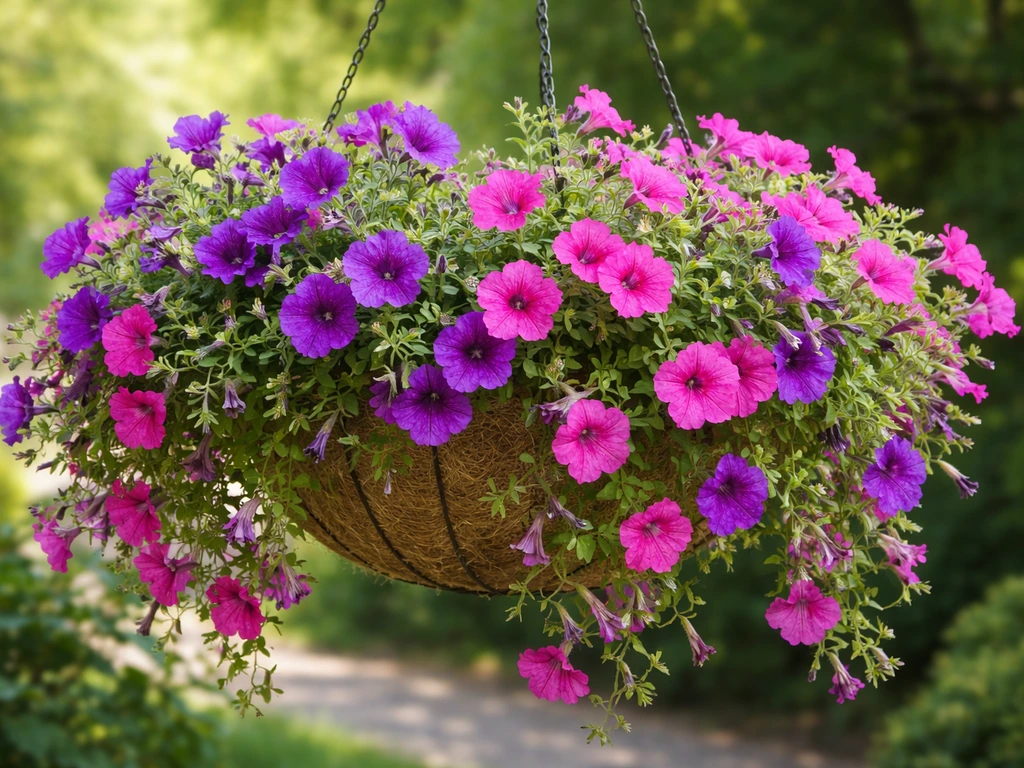
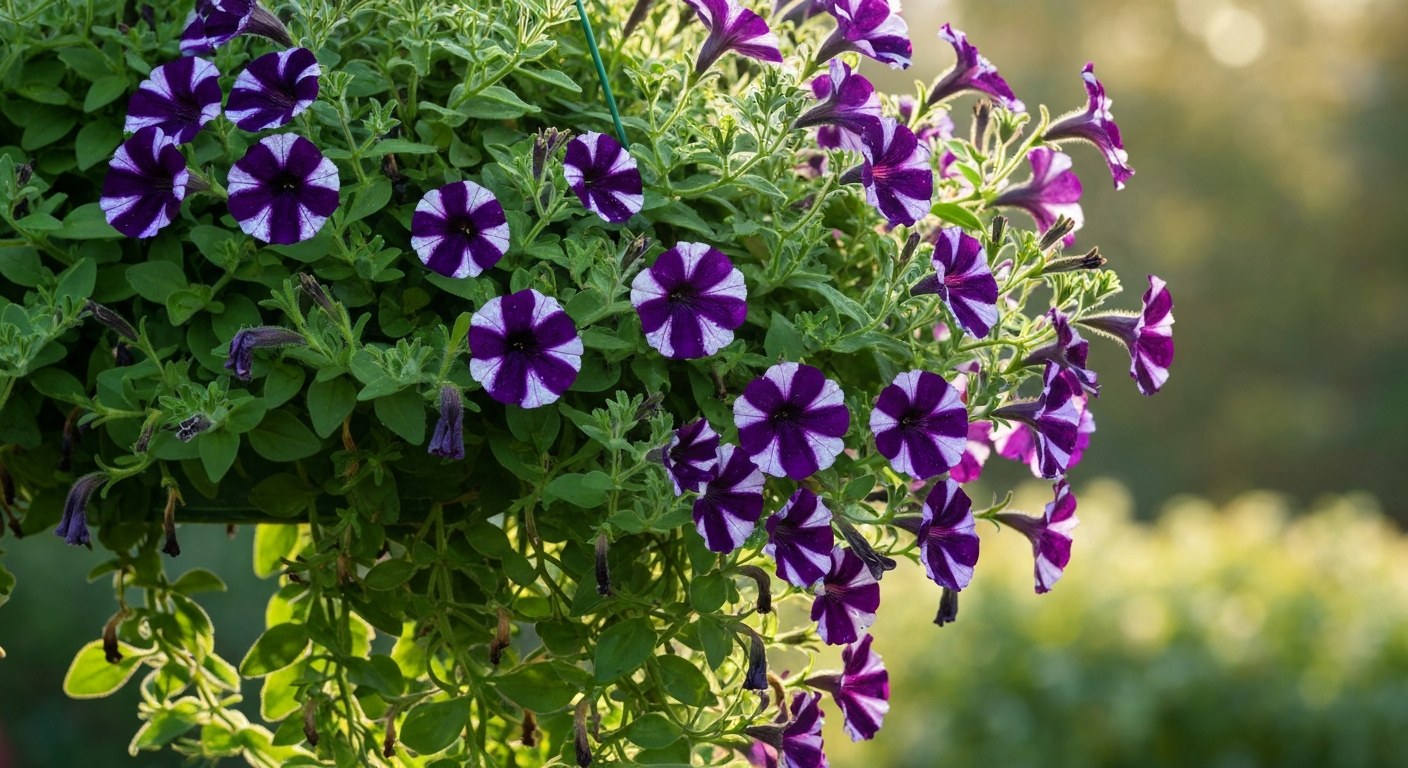
Night Sky petunia is a patented, vegetatively propagated cultivar (Headliner™ Night Sky® by Selecta One) that produces deep purple blooms splashed with white speckling that genuinely looks like a star field. You can start it from seed indoors 10 to 12 weeks before your last frost at 70 to 75°F, or buy licensed plugs for the most reliable pattern. Either way, it needs full sun, well-draining soil at pH 5.4 to 5.8, consistent moisture, and regular feeding at 200 to 300 ppm nitrogen to hit its 10 to 16 inch height and 20 to 30 inch spread by mid-summer.
How to Grow Night Sky Petunia: Complete Seed-to-Bloom Guide

Harriet Whitmore
14 Jul 2026
What Night Sky petunia actually is (and why it's worth the fuss)
Night Sky petunia entered the market around 2015 after winning the European FleuroStar award and is protected by U.S. plant patents. It belongs to Selecta One's Headliner Sky series, a line bred for container performance and eye-catching flower patterning. What makes it genuinely special is that no two blooms look identical. The white spots are temperature-sensitive: cooler nights (around 50 to 60°F) and bright light increase the speckling, while warm, low-light conditions can reduce it to nearly plain purple. That quirk makes it a little unpredictable, which is half the fun and also something worth understanding before you're disappointed by a hot July plant with fewer stars.
Most growers find it best suited for hanging baskets and large containers, where the trailing stems can spill and you can appreciate the flowers up close. It's also striking as a front-of-border edging plant or in combination planters paired with silver or chartreuse foliage. The realistic seed-to-first-bloom window runs 12 to 16 weeks from seed, or about 4 to 6 weeks from a rooted plug if you're starting with commercially available liners.
Night Sky vs. wave, Surfinia, and Supertunia: which one do you actually want?
All four are vegetatively propagated petunia types with trailing habits and strong container performance, but they're quite different in practice. Night Sky is grown primarily for its flower pattern rather than for sheer volume of bloom or ground-covering spread. Wave petunias are bred for aggressive spreading (up to 4 feet wide) and self-cleaning, making them better for mass beds and low-maintenance situations. Surfinia petunias are vigorous trailing types with excellent weather tolerance, better suited to exposed window boxes and baskets where rain resistance matters. For detailed instructions on how to grow Surfinia petunias, see how to grow surfinia petunias. Supertunias are bred for high bloom count and heat tolerance, producing more flowers per stem than Night Sky and requiring less coddling through the season. The trade-off is that none of them have Night Sky's star pattern.
| Type | Spread | Primary use | Self-cleaning | Pattern interest | Heat tolerance |
|---|---|---|---|---|---|
| Night Sky (Headliner™) | 20–30 in | Containers, baskets, edging | Moderate | Very high (star pattern) | Moderate |
| Wave petunia | Up to 48 in | Mass beds, ground cover | Yes | Low | High |
| Surfinia petunia | 24–36 in | Window boxes, baskets | Yes | Low | High |
| Supertunia | 20–36 in | Containers, baskets | Yes | Low | Very high |
If your main goal is a statement container or a gift-worthy hanging basket, Night Sky is the right pick. If you want to fill a large bed with minimal upkeep, wave or Surfinia will serve you better. If summer heat is brutal in your zone and you want flowers from June through October with little deadheading, look at Supertunias instead. Night Sky rewards a bit more attention in exchange for a flower that genuinely stops people in their tracks.
Where and how to use Night Sky in your garden
Night Sky reaches 10 to 16 inches tall and spreads 20 to 30 inches, so it's a mid-size trailer rather than a sprawling ground cover. Hanging baskets in the 12 to 14 inch diameter range work well, with one plant per basket giving it room to fill out. In combination containers, pair it with upright plants (ornamental grass, salvia, or dracaena spike) and a spiller like sweet potato vine. For bed edging, space plants 12 to 18 inches apart at the front of a border where they can drape over pathways. Avoid planting Night Sky in full ground-bed situations where they'll be shaded out by taller neighbors: it needs at least 6 hours of direct sun daily, and ideally more in cooler climates to enhance the star pattern.
One placement tip I've learned from experience: position Night Sky baskets where you get some cooler nights, even in summer. A spot on a north-facing porch that gets morning sun and afternoon shade in zones 8 and above will keep night temperatures lower than a south-facing wall, which helps maintain the white spotting through the hottest part of the season.
Everything you need before you start
- Seed or vegetative plugs: seed is available from third-party sellers but may not come true-to-type; licensed plugs from Ball Seed, Germania, or retailers like Burpee give the most reliable pattern
- 72-cell plug tray or small cells around 25 mm diameter (as specified in Selecta's culture sheet)
- Fine, sterile soilless seed-starting mix (peat or coco-based, pH 5.4–5.8)
- Thermostatically controlled heat mat set to 70–75°F (21–24°C) for germination
- Full-spectrum LED or T5 fluorescent grow lights capable of delivering 100–200 µmol·m⁻²·s⁻¹ PPFD
- Humidity dome (used only until radicles emerge, about 7–9 days)
- Liquid water-soluble fertilizer with a balanced or high-nitrogen formula (target 250–300 ppm N)
- Containers or hanging baskets with drainage holes (12–14 in diameter minimum for baskets)
- Perlite or coarse sand to improve drainage in potting mixes
- Sterile propagation mix for cuttings (different from seed-starting mix: very free-draining)
- Sharp, clean pruning snips or a razor blade for taking cuttings
- Optional: rooting hormone powder or gel (IBA-based), though Selecta's culture sheet notes it is not required for this cultivar
Starting Night Sky from seed, step by step
A quick but important caveat before you start: seed-grown Night Sky plants often do not replicate the exact star pattern because the cultivar is a protected, vegetatively propagated selection. You may get beautiful patterned petunias from seed, or you may get mostly purple flowers with minimal speckling. If the pattern is your whole reason for growing it, start with licensed plugs. That said, seed is accessible and worth trying, especially if you're experimenting. Here's how to give the seeds the best chance. Extension guidance in Starting Plants From Seed, University of New Hampshire Extension (fact sheet) recommends a sterile, fine, soilless seed‑starting mix, surface‑sowing petunia seed, keeping the medium evenly moist with consistent temperature and light, and thinning or transplanting when seedlings have 1–2 true leaves Starting Plants From Seed — University of New Hampshire Extension (fact sheet).
- Timing: count back 10 to 12 weeks from your average last frost date. In zone 6 (last frost late April), start seeds in early to mid-February. In zone 9 (last frost late January), start in early November for spring planting.
- Fill 72-cell plug trays with a fine, sterile soilless mix. Moisten the mix thoroughly before sowing so you're not washing seeds around after they land.
- Sow seeds on the surface. Petunia seeds need light to germinate, so do not cover them with mix. Press them gently onto the surface to ensure contact but leave them exposed.
- Mist lightly with a spray bottle, then cover the tray with a clear humidity dome to hold moisture.
- Place the tray on a heat mat set to 70–75°F (21–24°C). Place grow lights 2 to 4 inches above the dome running 14 to 16 hours per day. Germination typically occurs in 7 to 10 days.
- As soon as you see radicles (tiny white root tips) or cotyledons emerging, remove the humidity dome. Leaving it on too long encourages damping-off fungus.
- Keep the medium evenly moist, not waterlogged. Water from below by setting trays in a shallow tray of water for 10 to 15 minutes, then drain. This keeps seeds from being dislodged and keeps foliage dry.
- Once seedlings show 1 to 2 true leaves (the leaves after the initial seed leaves), thin to the strongest seedling per cell.
- Begin feeding with a dilute liquid fertilizer at 100 ppm nitrogen once true leaves appear, increasing to 200 ppm as plants size up.
- Harden off seedlings over 7 to 10 days before transplanting outdoors: start with 1 to 2 hours of outdoor shade, gradually increasing exposure to direct sun over the week.
Image suggestion: A close-up of a 72-cell plug tray with tiny Night Sky petunia seedlings at the cotyledon stage, showing the surface-sown seeds and the heat mat beneath. A second image showing seedlings with 2 true leaves ready for thinning.
Propagating Night Sky from cuttings
Cuttings are the reliable way to reproduce Night Sky with the pattern intact, and they're straightforward once you've done it once. Selecta's production data shows a 4-week propagation time with an average of 7 to 9 days of misting before roots are established. At home, you won't have commercial mist benches, but you can replicate the high-humidity early stage with a clear plastic bag or dome. Selecta's Headliner™ Night Sky culture sheet, Selecta (media pH, watering, disease note) recommends maintaining media pH at 5.4–5.8 during propagation and finish, keeping substrates constantly moist but well‑drained, and applying a preventive fungicide at sticking to reduce damping‑off Headliner™ Night Sky culture sheet — Selecta (media pH, watering, disease note).
- Timing: take cuttings in late winter (January to February) from an overwintered stock plant, or in early spring from a new purchased plant before it's been transplanted outdoors. Cuttings from actively growing, non-flowering stem tips root fastest.
- Select a healthy stem tip 3 to 4 inches long with at least 2 to 3 nodes. Cut cleanly just below a node with a sterilized blade.
- Strip the lower leaves, leaving 2 to 3 leaves at the tip. Remove any flower buds or open blooms so the cutting puts energy into rooting rather than flowering.
- Selecta's culture sheet notes that rooting hormone is not required for this cultivar commercially, but dipping the cut end in IBA-based rooting powder or gel can accelerate home propagation.
- Insert the cutting 1 to 1.5 inches deep into a small cell or 2-inch pot filled with a very free-draining sterile propagation mix (50:50 perlite and peat or coco coir). Firm gently.
- Water in well and immediately enclose the pot in a clear plastic bag or place under a humidity dome to maintain high humidity around the foliage. This reduces wilting while roots haven't yet formed.
- Place under grow lights at 14 to 16 hours per day. Keep media pH 5.4 to 5.8 and temperature 65 to 75°F (18 to 24°C) during rooting. Avoid letting the mix dry out, but do not let it stay waterlogged.
- After 7 to 9 days, gently tug the cutting. If there's resistance, roots are forming. Remove the humidity dome or open the bag for increasingly longer periods each day over the next week to acclimate the cutting.
- By week 4, cuttings should have a developed root ball. Pot up into a larger container with a quality peat- or coco-based potting mix and begin a regular feed program.
Image suggestion: Step-by-step propagation photos showing a stem tip cutting being stripped of lower leaves, the cutting inserted into a propagation cell, and a rooted cutting at week 4 with visible root development when gently removed from the cell.
How to get Night Sky to bloom faster
The biggest lever you have for accelerating bloom is light, especially in the seedling and plug stage. For more practical steps to speed flowering and overall growth, see how to grow petunia fast. Night Sky targets 5,000 to 6,000 foot-candles at the crop level according to Selecta's culture guidance, which is higher than many home setups provide. Etiolated, stretched seedlings growing under weak light take far longer to branch and bloom than compact seedlings grown under strong LED or T5 lighting. Get your light source close: 2 to 4 inches above seedlings for T5 fluorescents, 6 to 12 inches for LED panels, depending on their intensity.
- Start early enough: sow 10 to 12 weeks before last frost so plants are well developed before going outside
- Maximize photoperiod indoors: run lights 14 to 16 hours per day to encourage fast vegetative growth
- Keep temperatures consistent: 65 to 75°F days and 50 to 60°F nights; don't let seedlings sit in cold drafts near windows in winter
- Pinch once at transplant: nip the growing tip back to 4 to 6 leaves when transplanting to encourage 3 to 5 lateral branches instead of one central stem; this adds 1 to 2 weeks before first bloom but produces many more flowers in the long run
- Feed aggressively once plants are established: 250 to 300 ppm nitrogen at every watering during active growth, switching to a higher potassium formulation once buds appear to harden flowers
- Transplant into final containers rather than stepping up through multiple small pots: every transplant causes a brief growth pause, so if your plug or seedling has a good root ball, go straight to a 10 to 12 inch pot or basket
- Harden off thoroughly: plants shocked by sudden cold or intense direct sun after being indoors stall for a week or more before resuming growth
Planting and everyday care
Soil, containers, and spacing
Night Sky performs best in a well-draining, slightly acidic potting or garden soil with a pH of 5.4 to 5.8. In containers, use a quality peat- or coco-based potting mix amended with about 20 to 25 percent perlite for drainage. Avoid heavy garden soil in pots: it compacts, drains poorly, and Night Sky roots sitting in wet soil will rot quickly. For garden beds, work in compost and coarse grit if your soil is heavy clay. Spacing in beds: 12 to 18 inches apart. In hanging baskets, one plant per 12-inch basket is plenty; for 14-inch and larger baskets, two plants work. For a full beginner's guide, see our article on how to grow petunia.
Sun, watering, and mulching
Full sun (6 or more hours direct sun daily) is non-negotiable for good bloom density and for the star pattern to show up well. In zones 8 and above, afternoon shade can help prevent heat stress, but morning sun is essential. Water when the top inch of soil feels dry. Container plants in summer heat may need daily watering; garden-bed plants every 2 to 3 days depending on rainfall and soil type. Always water at the base rather than overhead to keep foliage dry and reduce fungal disease risk. In beds, a 2-inch layer of mulch conserves moisture and moderates soil temperature, which can help maintain cooler root-zone conditions that benefit the flower pattern.
Feeding schedule
Night Sky is a heavy feeder. A water-soluble balanced fertilizer (such as 20-10-20 or 15-5-15) applied at 200 to 300 ppm nitrogen at every watering during vegetative growth works well. Once flower buds appear, shift to a higher-potassium formula (like 15-5-30 or a tomato-type fertilizer) to strengthen bloom color and increase flower size. If you prefer a simpler approach, a slow-release granular fertilizer worked into the potting mix at planting, topped up with liquid feeding every 7 to 14 days, also works. Watch for pale yellow-green leaves: that's usually nitrogen deficiency calling for more frequent feeding, not a disease.
| Growth stage | Fertilizer type | Rate/frequency | Notes |
|---|---|---|---|
| Seedling (after true leaves) | Liquid balanced (20-10-20) | 100 ppm N, every watering | Dilute; roots are sensitive |
| Active vegetative growth | Liquid balanced (20-10-20 or 15-5-15) | 250–300 ppm N, every watering | Or slow-release granular at planting + liquid every 14 days |
| Bud and bloom stage | High-K liquid (15-5-30 or bloom booster) | 200 ppm, every 7–10 days | Strengthens color and flower size |
| Midsummer maintenance | Balanced liquid | 200 ppm, every 7 days | Increase if growth slows or foliage yellows |
Pinching, pruning, and training for the best shape
The single most impactful thing you can do for a Night Sky petunia is pinch it back at transplant time and again after the first flush of bloom. When you first transplant, pinch the central growing tip back to just above the fourth or fifth leaf pair. This forces the plant to branch from the base and produces a naturally bushy, full plant rather than a single leggy stem. After the first bloom flush (usually 4 to 5 weeks after transplanting), shear the whole plant back by one-third to one-half. It looks brutal, but plants bounce back within 2 weeks with fresh growth and a stronger second flush of blooms.
Deadheading individual spent blooms is less critical than with older petunia types, but it does keep the plant looking tidy and prevents seed set, which can slow subsequent blooming. For a trailing basket habit, avoid too-aggressive pruning of the long hanging stems: just remove the very tips and any weak shoots. For a more compact mound in a bed, shear more aggressively to keep the plant dense.
Image suggestion: A before-and-after photo set showing a young Night Sky plant before pinching at transplant (single stem with few branches) and the same plant 3 weeks later showing multiple lateral branches forming. A second image showing the correct pruning point one-third down a stem.
Seasonal planting timelines by USDA zone
Night Sky is a tender perennial treated as an annual in most of the U.S. In zones 10 and above it can overwinter outdoors, but in zones 3 through 9 it's planted after the last frost and either discarded at first freeze or brought indoors as a stock plant.
| USDA Zone | Last frost (approx.) | Start seeds indoors | Transplant outdoors | First bloom expected | End of season |
|---|---|---|---|---|---|
| Zone 3 (MN, ND) | Late May | Early to mid-March | Late May to early June | Mid to late July | First frost late Sept–Oct |
| Zone 5 (IL, PA) | Late April | Early to mid-February | Late April to mid-May | Late June to July | First frost Oct |
| Zone 6 (VA, KS) | Mid-April | Early February | Mid to late April | Mid-June | First frost late Oct–Nov |
| Zone 7 (NC, TN) | Late March | Mid to late January | Late March to April | Early June | First frost Nov |
| Zone 8 (TX, GA) | Mid-March | Early January | Mid to late March | Late May to early June | First frost Nov–Dec |
| Zone 9 (FL, CA coast) | Late January | Early November (prior year) | Late January to February | April to May | Year-round with heat break |
| Zone 10+ (S. FL, HI) | No frost | Year-round possible | Any time | 8–12 weeks after transplant | Year-round; rest in summer heat |
Overwintering Night Sky
In zones 9 and below, bring a healthy container plant indoors before the first frost. Cut it back by half, move it to a bright south-facing window or under grow lights, and reduce watering significantly (once a week or when soil is dry 2 inches deep). Fertilize lightly once a month at 100 ppm. The plant will go semi-dormant but survive. In late winter, resume regular watering and feeding, take cuttings from the new growth for additional plants, and harden it off again for outdoor planting in spring. This overwintered mother plant is your best source for true-to-type cuttings with the star pattern intact.
Pests, diseases, and how to deal with them
Night Sky faces the same pest and disease pressures as most petunias. Catching problems early is much easier than recovering from an established infestation, so check the undersides of leaves and growing tips every few days during the growing season.
| Problem | Symptoms | Organic control | Chemical control |
|---|---|---|---|
| Aphids | Sticky residue, curled new growth, clusters of small insects at stem tips | Blast off with water, neem oil spray, insecticidal soap | Pyrethrin spray, imidacloprid systemic |
| Thrips | Silvery streaking on petals and leaves, distorted flowers | Spinosad spray, sticky yellow traps | Bifenthrin, spirotetramat |
| Whitefly | White insects rising when plant is disturbed, sticky leaves, yellowing | Yellow sticky traps, insecticidal soap, neem oil | Pyrethrin, imidacloprid |
| Botrytis (gray mold) | Grayish fuzzy growth on stems and flowers, rapid collapse of tissue | Improve air circulation, remove affected parts, reduce overhead watering | Chlorothalonil or iprodione fungicide |
| Powdery mildew | White powdery coating on leaves, usually in humid conditions with poor air flow | Neem oil, baking soda spray, remove affected leaves | Myclobutanil, trifloxystrobin |
| Damping-off (seedlings) | Stem collapse at soil level in newly germinated seedlings | Use sterile mix, avoid overwatering, improve air circulation | Preventive drench with mefenoxam or copper fungicide |
| Root rot (Pythium/Phytophthora) | Wilting despite moist soil, brown mushy roots | Reduce watering, improve drainage, use well-draining mix | Mefenoxam drench; prevention is far easier than cure |
| Flea beetles | Small round holes in leaves, tiny jumping beetles | Diatomaceous earth, row cover at transplant | Carbaryl, pyrethrin spray |
The pattern fading issue mentioned earlier is not a disease. If your Night Sky flowers are coming out mostly purple with very little white, check your night temperatures (aim for 50 to 60°F), increase light levels, and make sure you're not over-fertilizing with nitrogen at the bloom stage, which pushes foliage at the expense of flower color intensity.
Image suggestion: A labeled diagnostic photo showing aphid clusters on a stem tip alongside a flower showing typical botrytis browning at petal edges, with a caption pointing to the early signs of each problem.
Realistic timelines and what to expect at each stage
- Seed germination: 7 to 10 days at 70 to 75°F with surface sowing and good light
- Seedling to plug stage (2 true leaves): 3 to 4 weeks from germination
- Plug to transplant-ready plant: another 4 to 6 weeks under lights indoors
- Transplant to first bloom: 4 to 6 weeks outdoors (from a well-developed plug or young plant)
- Seed to first bloom total: 12 to 16 weeks (10 to 12 weeks indoor growing plus 4 to 6 weeks after transplant)
- From commercial licensed plug at transplant: 4 to 6 weeks to first bloom
- Full mature size (10–16 in tall, 20–30 in spread): typically 8 to 10 weeks after transplanting outdoors
- Peak bloom period: mid-summer through early fall with proper feeding and pruning
Seed vs. plug: which route is right for you?
If pattern accuracy is your priority and you want guaranteed Night Sky performance, buy licensed vegetative plugs from Ball Seed, Germania, Burpee, or an independent nursery carrying the Headliner™ line. Seed-grown plants from marketplace sellers may produce lovely patterned petunias, but they can also revert to near-solid colors due to the genetic segregation that comes with seed reproduction of a patented vegetative cultivar. That said, if you enjoy the seed-starting process, enjoy surprise variation, or simply can't source plugs locally, seed is worth a try using the germination steps above. Just go in with realistic expectations.
For gardeners who are building their skills with annual seed starting, working through Night Sky alongside other petunia types is genuinely educational. The same principles covered here apply broadly across the petunia family. If you want to compare approaches for other trailing petunia types, the care routines for wave petunias and Surfinia petunias share several fundamentals with Night Sky, though each has its own quirks worth understanding before you plant.
FAQ
What SEO title and meta description should the article include?
Title: How to Grow Night Sky Petunia: Seed, Cuttings & Fast-Flowering Care Meta description (≤160 chars): Step-by-step guide to grow Night Sky petunia from seed or plugs—propagation, planting, feeding, pruning, pests, timelines and zone advice.
What authoritative cultivar background should be included?
Origin and breeder: Selecta One (Headliner™/Night Sky®), introduced ~2015 and commercially licensed. Plant patents and protection (e.g., US patents/plant patents). Distinctive traits: starry white-on-purple spotting, 10–16" height, 20–30" spread (breeder specs). Cite Selecta culture sheet and patent documentation.
How should differences between Night Sky and other petunia types be presented?
Compare growth habit, flower form and use: Night Sky (mounded/bushy/large spread, novelty spotted flowers); Wave/surfinia (prostrate, vigorous trailing for groundcover/hanging baskets); Supertunia (Supertunia™ series, vigorous, garden-ready with continuous bloom). Include when to choose each: choose Night Sky for novelty focal points and mixed containers; Wave/Surfinia for extensive groundcover or heavy spilling; Supertunia for low-maintenance mass bedding. Reference breeder pages (Selecta, Ball Seed) and extension summaries.
What seed-starting and germination specifics are needed?
Key parameters: sow indoors 10–12 weeks before last frost; use sterile, fine soilless mix; surface-sow (do not cover) because petunia seeds need light; germination temp 70–75°F (21–24°C); expect 5–10 days (commonly 7–10) to germinate; use 25 mm plug or 72-cell trays for small-scale (Selecta recommends 25 mm for Night Sky plugs); maintain even moisture, humidity dome until radicles; provide 14–16 hr photoperiod of full-spectrum LEDs or T5s and target seedling DLI ~10–12 mol·m⁻²·d⁻¹/PPFD ~100–200 µmol·m⁻²·s⁻¹; transplant at 1–2 true leaves or into larger cell. Cite Selecta culture sheet, NC State Extension, and lighting research (Purdue).
What cutting/vegetative propagation details should be included?
Commercial protocol: take 2–3" softwood cuttings, use small plug trays (25 mm), use sterile soilless media, keep media constantly moist, misting 7–9 days typical, average propagation ~4 weeks; Selecta notes no rooting hormone required (IBA/NAA not necessary), maintain media pH 5.4–5.8, day/night temps ~65–75°F/50–60°F (18–24°C/10–16°C). Include hygiene, sanitation, and optional IBA if home growers want faster rooting. Cite Selecta culture sheet and propagation fact sheets.
What fast-growth techniques ('how to grow petunia fast') are essential?
Timing and environment: start seedlings/plugs early enough (10–12 weeks pre-frost) and keep steady temps (day 65–75°F), high light (maximize DLI), and consistent moisture. Cultural tactics: use warm germination mats, full-spectrum grow lights, transplant to larger cells early to avoid root restriction, use balanced 20–10-20 or similar water-soluble fertilizer at 150–250 ppm N for growth phase then 250–300 ppm N per Selecta for finish, pinch once to promote branching, avoid overwatering to prevent damping-off. Reference breeder culture sheet, extension guidance and nutrient recommendations.
Next Article
How to Grow Surfinia Petunias From Seed to Bloom
Step-by-step Surfinia petunias from seed to bloom: timing, light, soil, feeding, pruning, watering, and fixes for common