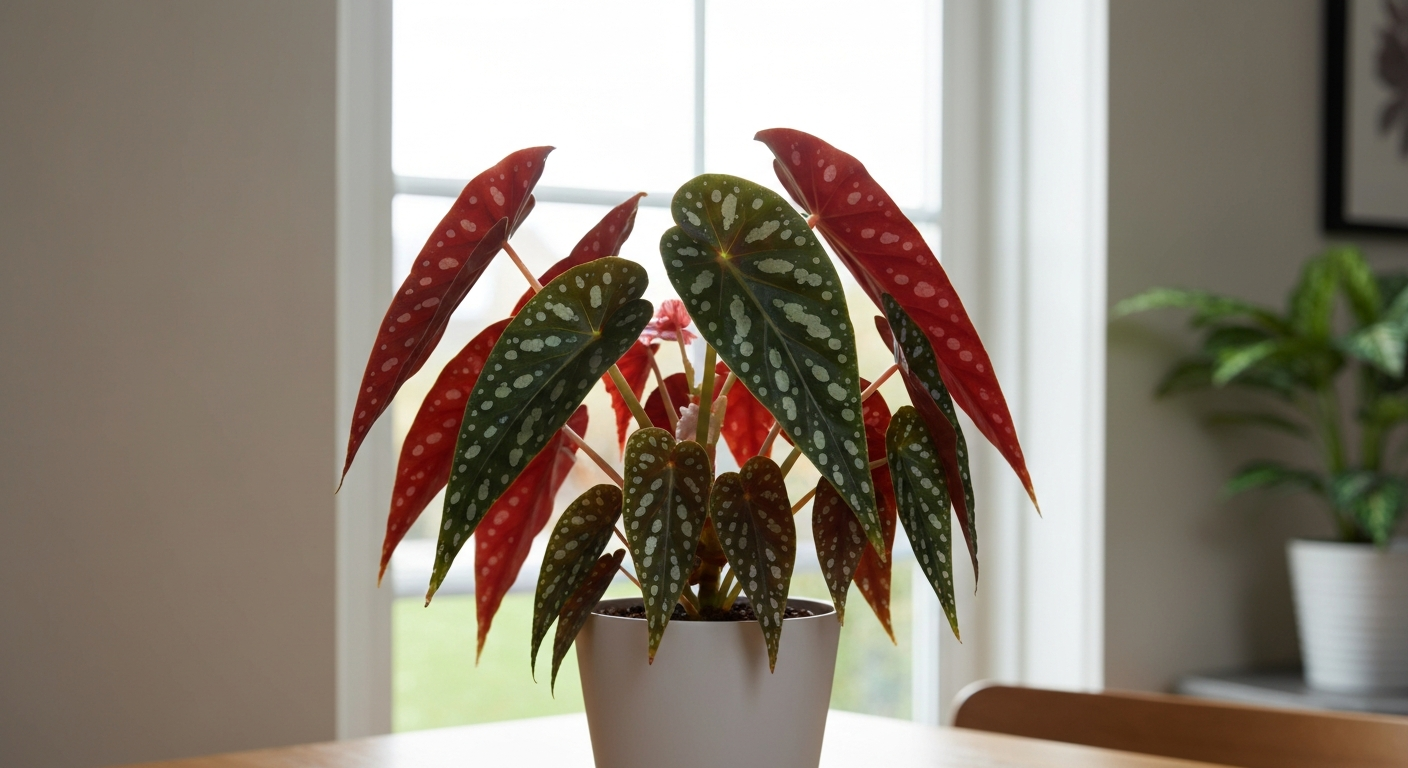
Begonia maculata, the polka dot begonia, grows best in bright indirect light, a free-draining peat-perlite-bark mix, and moderate to high humidity around 50–70%. Keep temperatures between 65–80°F (18–27°C), let the top inch of soil dry between waterings, feed every two weeks in the growing season, and pinch stems regularly to keep it bushy and blooming. It's a frost-tender tropical, so outside USDA zones 10–11 it lives happily as a houseplant year-round or moves outdoors in summer.
How to Grow Begonia maculata: Complete Care & Propagation

Harriet Whitmore
25 Jul 2026
Quick-care table: Begonia maculata at a glance
| Care factor | What to do | Notes |
|---|---|---|
| Light | Bright, indirect — 500–1,000 fc (≈5,000–10,800 lux) | East or west window within 0.5–1 m; sheer curtain on south |
| Watering | Water thoroughly when top ~1 inch (2.5 cm) of mix is dry | Drain fully; allow ~10–25% runoff to leach salts |
| Humidity | 50–70% RH preferred; minimum ~45% | Use a humidifier or pebble tray — avoid misting |
| Temperature | 65–80°F (18–27°C) daytime; nights above 55°F (13°C) | Keep away from cold drafts and heating vents |
| Soil | 1 part coir : 1 part perlite : 1 part orchid bark | Target pH 5.8–6.2 |
| Feeding | Balanced or bloom-boost liquid fertilizer every 2 weeks (growing season) | Dilute to half-strength; stop or reduce in winter |
| Pot size | 1–2 inches wider than root ball on repot | Repot when roots circle the drainage holes |
| Hardiness | USDA zones 10–11 outdoors; elsewhere treat as houseplant | Frost-tender; bring in before temps drop below 50°F (10°C) |
| Height / spread | 60–90 cm (2–3 ft) tall; 30–60 cm (1–2 ft) spread | Can grow taller with staking |
| Flowering season | Spring through summer (warm, bright conditions) | White or pale pink flower clusters beneath foliage |
Why Begonia maculata deserves a spot in your collection
Begonia maculata was formally described by Italian botanist Giuseppe Raddi in 1820, collected from the Atlantic Forest region of southeastern Brazil. In the wild it grows as an understory plant in warm, humid rainforest, which tells you almost everything you need to know about what it wants in your home. The asymmetrical, angel-wing shaped leaves are forest green on top, covered in those distinctive silver polka dots, and flushed red to dusky red on the undersides. It is a cane-type begonia, meaning it grows upright on bamboo-like jointed stems rather than forming a low rosette or trailing habit like some of its relatives.
In cultivation indoors, plants commonly reach 60–90 cm (roughly 2–3 ft) with a 30–60 cm spread, though a well-fed, staked specimen can push taller. The real draw is the foliage, it is genuinely striking in a way that makes visitors ask questions, but it will also produce small pendant clusters of white or pale pink flowers in spring and summer when conditions are right. If you have grown wax begonias (Begonia semperflorens) for outdoor bedding, be aware that B. maculata behaves quite differently: it needs more vertical space, more consistent humidity, and far more attention to drainage. Rex begonias share similar humidity preferences, but B. maculata is generally more forgiving about light and easier to propagate from cuttings.
Getting the light right
This is the single factor I see go wrong most often, even for experienced growers. Begonia maculata is a bright-indirect-light plant, sitting comfortably in the range of roughly 500–1,000 foot-candles (about 5,000–10,800 lux) at the leaf surface. That translates to a spot within about 0.5–1 metre (1–3 ft) of a bright east- or west-facing window, or a south-facing window filtered by a sheer curtain. In my experience, an east window is the safest starting point because it delivers gentle morning sun without the harsh midday exposure that a south window can produce.
Direct midday sun hits the thin, spotted foliage hard and causes scorch, you will see tan or bleached patches on the upper leaf surface within a day or two of exposure. On the flip side, too little light results in pale, washed-out spots, elongated weak stems, and very few flowers. A light meter (even an inexpensive smartphone app) takes the guesswork out of placement and is worth using at least once to calibrate your eye. In winter, when ambient light levels drop significantly in higher latitudes, moving the plant a foot closer to the window or supplementing with a full-spectrum grow light for 12–14 hours a day makes a real difference.
| Symptom | Likely cause | Fix |
|---|---|---|
| Bleached or tan patches on leaves | Too much direct sun / scorch | Move back from window or add sheer curtain |
| Pale, faded spot color; leggy stems | Too little light | Move closer to window; add grow light in winter |
| Spots turn yellow-green rather than silver | Low light over extended period | Increase light gradually over 7–10 days |
| Flowers absent despite healthy foliage | Insufficient bright light | Target the higher end of the 500–1,000 fc range |
Building the ideal potting mix
Standard potting soil straight from a bag is usually too dense and moisture-retentive for B. maculata. The roots of cane begonias want moisture but they also need air around them, soggy, compacted soil is the fastest route to root rot. The American Begonia Society recommends building your own blend that balances drainage with just enough moisture retention, and after trying various ratios myself, this three-component mix is what I now use for all my cane begonias. A tested home recipe is 1 part peat moss or coco coir : 1 part coarse perlite or pumice : 1 part small orchid bark, a free‑draining yet moisture‑retentive mix suitable for cane begonias (Growing Media | American Begonia Society) Growing Media | American Begonia Society (soil/media guidance).
Potting-mix recipe (by volume)
- Measure 1 part coconut coir (or peat moss) into a mixing container — this provides moisture retention and a slightly acidic base.
- Add 1 part coarse perlite or pumice — this is what keeps the mix airy and prevents compaction over time.
- Add 1 part small orchid bark or screened pine bark fines — these larger particles create macro-pore space so water drains freely and air circulates to the roots.
- Mix thoroughly and wet the blend evenly before potting — dry coir in particular is hydrophobic until fully moistened.
- Check pH if possible: target 5.8–6.2. If your water is very alkaline or your coir reads higher than 6.5, add a small amount of horticultural sulfur or use a pH-adjusted water source. Amend with dolomitic lime only if pH drops below 5.5.
- Fill the pot to about one-third, set the root ball, backfill and gently firm around the sides. Do not bury the stem deeper than it was growing previously.
If you prefer a commercial shortcut, a 50/50 mix of a quality peat-based potting compost and horticultural perlite gets you reasonably close. Just avoid any mix containing a lot of composted bark fines that are already broken down, these compact quickly and lose their drainage properties within a growing season.
Watering: the detail that separates success from failure
Begonia maculata wants consistent moisture but it absolutely cannot sit in waterlogged soil. The practical rule I follow: water thoroughly when the top ~1 inch (2.5 cm) of potting mix has dried out, confirmed either by pushing a finger 2.5 cm into the mix or lifting the pot (a noticeably light pot is usually ready to water). When you do water, keep going until water drains freely from the drainage holes, that full soak ensures the whole root zone gets wet and helps flush accumulated fertilizer salts. Let the pot drain completely before setting it back in its saucer.
Seasonal watering calendar
| Season | Typical frequency | Key check |
|---|---|---|
| Spring (active growth resuming) | Every 4–6 days | Check every 3 days; increase as growth accelerates |
| Summer (peak growth, warm/bright) | Every 3–5 days | May need watering every 2–3 days near a sunny window |
| Autumn (growth slowing) | Every 6–8 days | Extend dry-down interval as light levels drop |
| Winter (low light, cooler temps) | Every 8–14 days | Finger-test is more important than a fixed schedule |
Moisture meters can be a useful cross-check but take their readings with some skepticism, inexpensive pronged meters measure electrical conductivity, which fertilizer salts can skew. Use the meter reading alongside the finger test and pot-weight method rather than relying on it alone. Signs of overwatering include yellowing lower leaves, soft mushy stems at the base, and a sour smell from the soil. Underwatering shows up as wilting, dry crispy leaf edges, and very light pot weight.
Humidity and temperature: creating a tropical microclimate
This plant comes from the humid Atlantic Forest and it shows. Target 50–70% relative humidity for the best leaf condition and silver spots. Many growers see acceptable performance in the 45–60% range, but if humidity drops below 40–45% for extended periods, as it commonly does in centrally heated or air-conditioned rooms, expect brown, crispy leaf edges and a surge in spider mite activity. A small ultrasonic humidifier placed nearby (not blowing directly at the foliage) is the most reliable solution. A pebble tray filled with water and set under the pot adds modest humidity to the canopy microclimate. Grouping B. maculata with other moisture-loving plants also helps.
What I would steer you away from is frequent misting. It feels like the obvious solution, but wetting the leaves in stagnant indoor air creates exactly the conditions that bacterial leaf spot and powdery mildew prefer. The RHS makes this same point clearly: keep the leaves dry and raise ambient humidity through other means. Temperature-wise, 65–80°F (18–27°C) during the day is the sweet spot, with nights staying above 55°F (13°C). Cold drafts from windows or doors in winter are a common hidden stressor, if your plant sits near a drafty window and starts dropping leaves in late autumn, moving it a few feet inward can solve the problem overnight.
Feeding for growth and flowers
Begonia maculata is a moderate feeder that responds well to a consistent fertilizing routine during the growing season. From spring through summer, I feed every two weeks with a balanced water-soluble fertilizer (such as a 20-20-20 NPK formulation) diluted to half the label strength, full-strength liquid fertilizer on begonias risks fertilizer burn, especially if the soil is at all dry. Once buds begin to form and I want to encourage the flower clusters, I switch to a formula with a slightly higher middle number (potassium-phosphorus-forward, such as a 10-30-20) for a few weeks.
In autumn, as light levels decrease and growth slows, I taper feeding to once a month. Through winter I stop fertilizing almost completely or apply at quarter-strength at most, pushing growth in low-light conditions produces the weak, etiolated stems that are prone to flopping. Resume regular feeding as soon as new growth appears and light levels increase in spring, usually around March at mid-latitudes. Always water the plant before applying liquid feed to avoid applying fertilizer to dry roots.
Pruning, pinching and training for a fuller plant
Left unpinched, B. maculata grows tall and leggy, a single cane reaching for the ceiling with leaves only at the top. Regular pinching and pruning changes that dramatically. The technique is simple but timing matters.
- Start pinching when a new stem reaches about 15–20 cm (6–8 inches) long. Use clean, sharp scissors or fingertips to remove the growing tip just above a leaf node.
- Each pinched tip will typically produce two new shoots at that node, doubling the branching and creating a bushier canopy.
- Repeat the process on each new shoot once it extends another 15 cm or so — this is especially important in the first growing season to build a good framework.
- For established plants, do a harder prune in late winter or early spring (before new growth begins) by cutting canes back by up to one-third. This encourages fresh basal growth and rejuvenates an older plant that has become bare at the base.
- When pruning, cut just above a leaf node at a 45-degree angle to direct water away from the cut.
- Save the cuttings from any hard prune — they make excellent propagation material (more on that below).
- If you want to grow a taller specimen, insert a slim bamboo stake and gently tie the main cane at intervals rather than pinching it. This is how polka dot begonias get grown as tall standards or column specimens.
Which propagation method should you choose?
Begonia maculata is genuinely easy to propagate compared with some other houseplants, and you have a few routes available depending on your confidence level and what materials you have on hand. Stem cuttings in soil are the most reliable for producing sturdy, well-rooted plants. Water propagation is a great starting point if you are new to cuttings and want to watch the root development. Division works when you have a mature, multi-stemmed plant and want to split it. True corm or tuber storage is primarily relevant for tuberous begonias (like the large-flowered hybrid types grown from corms), B. maculata is a cane type that grows from a fibrous rhizome rather than a discrete corm, so the corm-storage approach used for tuberous varieties does not directly apply here. If you are growing tuberous types, there is separate guidance on how to grow begonia corms on this site worth reading alongside this article.
| Method | Best time | Skill level | Time to roots | Notes |
|---|---|---|---|---|
| Stem cutting in soil | Spring–early summer | Beginner | 3–5 weeks | Most reliable; produces strongest plants |
| Stem cutting in water | Spring–summer | Beginner | 2–4 weeks | Easy to monitor; transition to soil carefully |
| Division (rhizome) | Spring at repot time | Beginner | Immediate | Good for large, crowded plants |
| Leaf cutting | Spring–summer | Intermediate | 4–8 weeks (slow) | Possible but not common for cane types; better for Rex |
Step-by-step: stem cuttings in soil
This is my go-to method and the one I recommend to anyone starting out. Spring through early summer is the best window because the plant is actively growing and roots establish quickly in the warming temperatures.
- Gather clean, sharp scissors or a knife, small pots (9–10 cm / 3.5 inch), your free-draining begonia mix (or a 50/50 perlite/coir blend), and optionally a rooting hormone powder or gel.
- Select a healthy non-flowering stem with at least 2–3 leaf nodes. Cut a 10–15 cm (4–6 inch) length just below a node using a clean cut.
- Remove the leaves from the bottom node or two, leaving at least one or two healthy leaves at the top.
- Allow the cut end to air-dry for 15–30 minutes — this brief callusing reduces the chance of rot once potted.
- Dip the cut end in rooting hormone if using, tap off the excess, and insert the cutting about 2.5–4 cm (1–1.5 inches) deep into pre-moistened mix.
- Firm the mix gently around the cutting and place the pot in a warm spot with bright indirect light — avoid direct sun at this stage.
- Optionally cover with a clear plastic bag or a propagator lid to retain humidity, but crack it open for 30 minutes daily to prevent fungal build-up.
- Check for rooting at 3–5 weeks by giving a very gentle tug — resistance means roots are forming. Alternatively wait until you see new leaf growth at the tip.
- Once clearly rooted, remove the humidity cover, allow the plant to acclimatize over a week, then begin feeding at quarter-strength.
- Troubleshooting: if the cutting goes limp and soft at the base, it has rotted — likely from too much moisture or skipping the callusing step. Start fresh with a new cutting on drier mix. If leaves drop but the stem stays firm and green, the cutting is stressed but often recovers; keep it humid and be patient.
Step-by-step: water propagation
Water propagation is satisfying because you can watch the roots develop in real time, which makes it a great teaching method too. The trade-off is that water-grown roots are initially finer and less structured than soil roots, so the potting-up step needs a little care. See the site's guide on how to grow begonia in water for step-by-step water propagation instructions.
- Take a stem cutting the same way as for soil — 10–15 cm long, at least 2 nodes, lower leaves removed.
- Place the cutting in a clean glass or jar filled with room-temperature water, submerging 1–2 nodes but keeping the leaves above the waterline.
- Position in bright indirect light and change the water every 3–4 days to prevent stagnation and bacterial growth.
- You should see white root nubs emerging within 2–4 weeks. Wait until roots are at least 2.5–4 cm (1–1.5 inches) long before potting up — shorter roots break easily during transfer.
- To pot up, prepare a small pot with pre-moistened mix (use the same recipe as above). Make a hole in the center with a pencil or finger.
- Gently lower the rooted cutting into the hole, being careful not to snap the fragile water-grown roots. Firm the mix gently around the stem.
- Water lightly and place in bright indirect light. For the first week, loosely tent with a plastic bag to ease the transition from high-humidity water to soil — these water-grown roots need time to adapt.
- After about 7–10 days, remove the cover and resume normal care. Expect a brief adjustment period where the plant looks slightly sorry for itself — this is normal and it will push through.
Step-by-step: division and rhizome restart
Begonia maculata grows from a fibrous, somewhat thickened rhizome at the base, not a discrete corm like the tuberous types. When a mature plant becomes crowded or produces multiple crowns at the base, spring repotting is a good opportunity to divide it.
- Water the plant 24 hours before dividing to reduce transplant stress on the roots.
- Tip the root ball out of its pot and gently shake or tease away loose potting mix to expose the root structure.
- Identify natural separation points where distinct stem clusters arise from separate sections of the rhizome.
- Using clean, sharp scissors or a knife, cut cleanly through the rhizome between clusters. Aim for each division to have at least 2–3 stems and a healthy section of roots.
- If any cut surface looks soft or brown, trim back to firm white or cream tissue and dust lightly with powdered cinnamon or a sulphur-based fungicide as a precaution.
- Pot each division into an appropriately sized container (just large enough to accommodate the roots) using fresh mix.
- Water sparingly for the first week — just enough to moisten the mix — and keep in warm indirect light while the divisions settle.
- New leaf growth within 2–4 weeks indicates successful establishment; resume normal watering and feeding at that point.
A note on corms: if you have arrived here because you are growing large tuberous begonias with discrete bulb-like corms and want guidance on storing them over winter, B. maculata is a different kind of plant and the corm-storage method does not apply directly. The site's dedicated guide on how to grow begonia corms covers that process in full.
Repotting and choosing the right pot size
Begonia maculata does not need to be repotted on a rigid annual schedule, it actually performs reasonably well when slightly root-bound, and an oversized pot holding excess moisture is more dangerous than a snug one. The trigger to repot is roots circling visibly out of the drainage holes, roots pushing up through the soil surface, or a noticeable slowdown in growth despite good light and feeding during the active season. In practice, most plants need repotting every one to two years.
When you do repot, choose a new container only 1–2 inches (2.5–5 cm) wider than the current one. Jumping to a much larger pot means a lot of un-rooted mix surrounding the root ball, which stays wet for too long and invites rot. Spring is the best time, the plant is heading into its growth phase and will fill the new space quickly. Use fresh potting mix rather than topping up the old mix, which will have broken down and compacted. Terracotta pots are worth considering: they are breathable and dry out faster than plastic or glazed ceramic, which suits the drainage preferences of this plant nicely.
Signs your plant is root-bound and needs repotting
- Roots emerging from drainage holes and circling the pot base
- Soil drying out unusually fast — within a day of watering in normal conditions
- Plant wilts quickly despite being watered adequately
- Visible roots pushing up through the soil surface
- Noticeably slower growth than usual during peak spring/summer season
- Pot feels very heavy and roots are densely matted when tipped out
Seasonal care timelines by USDA zone and growing situation
Where you live determines quite different seasonal rhythms for this plant. I will break this into three groups: indoor growers in any zone, outdoor growers in warm zones 10–11, and growers in zones 4–9 who move the plant outside in summer.
Indoor growers (all zones), spring through winter checklist
| Season | Indoor care actions |
|---|---|
| Early spring (Feb–Mar) | Resume twice-monthly feeding; move closer to window as light improves; check for root-bound conditions and repot if needed; take cuttings for propagation |
| Late spring (Apr–May) | Increase watering frequency as growth accelerates; pinch stem tips on new growth; begin switching to bloom-focused fertilizer if buds appear |
| Summer (Jun–Aug) | Peak growing season: water frequently, maintain humidity with humidifier, feed every 2 weeks; enjoy flowers; prune after flowering for another flush |
| Autumn (Sep–Oct) | Taper feeding to once a month; reduce watering frequency slightly; move away from cold window glass as outside temps drop |
| Winter (Nov–Jan) | Minimal or no feeding; water only when top inch dries out (may be every 10–14 days); supplement with grow light if near a north window; avoid cold drafts |
Zones 10–11: outdoor or semi-outdoor culture
In USDA zones 10–11, Begonia maculata can grow outdoors year-round in a sheltered spot with filtered shade. Site it under a patio roof, beneath high tree canopy, or on a north-facing wall in the warmest zones, anywhere that gets bright ambient light without direct midday sun. In these zones, growth barely slows in winter and the plant can reach its full size potential. Mulch the root zone in any period where overnight temperatures approach 50°F (10°C). Water during dry spells since natural rainfall in these zones can be unpredictable.
Zones 4–9: summer outdoor rotation
If you live in zones 4–9, your polka dot begonia can spend the warmer months outdoors in a container, which typically accelerates growth and encourages flowering. Move it out after your last frost date when nights are reliably above 55°F (13°C), in zone 6, for example, that is usually mid-May. Acclimatize it over 7–10 days by starting in a sheltered, shadier spot before moving to its final position. Bring it back indoors in early autumn well before nighttime temperatures drop to 50°F (10°C), do not wait for a frost warning. September is often the right time in zones 5–6.
Container culture: pots, drainage and hanging baskets
Most growers keep B. maculata in a standard upright container and that is absolutely the right approach for a cane type that wants to grow vertically. If you are choosing a pot material, terracotta is my preference for the reasons mentioned above, the evaporation through the walls gives you a buffer against overwatering. Plastic pots are fine if you adjust your watering habits to account for slower drying. Whatever the material, drainage holes are non-negotiable: no drainage is a guarantee of root problems.
The site's guide on how to grow weeping begonia covers trailing/basket types that genuinely suit hanging containers. Begonia maculata, being an upright cane grower, is less suited to hanging baskets, it tends to look top-heavy and the canes are somewhat brittle. If you do try it in a hanging pot, keep the plant pinched back hard so it stays compact, and be very attentive to watering since hanging baskets dry out significantly faster than floor-standing containers. The mobility advantage of containers is real though: being able to carry B. maculata indoors in autumn and back out in late spring is how most gardeners in temperate zones enjoy this plant successfully.
Growing Begonia maculata in the garden
In zones 10–11, B. maculata can be planted directly into garden beds, where it makes a striking foliage accent in shaded tropical borders. Choose a site with dappled or partial shade, under a light tree canopy, on a north-facing border, or beneath an overhanging roof on the south-facing side of a structure. Soil in the ground needs to be improved the same way as container mix: dig in generous amounts of composted bark, coarse grit or perlite, and ideally some coir or peat to create a well-structured, free-draining but moisture-retentive bed. Raised beds often work better than flat ground in heavier soils.
Mulching is important in garden culture: a 5–7 cm (2–3 inch) layer of fine bark mulch around the base helps retain soil moisture, moderates root-zone temperature, and suppresses weeds without waterlogging the crown. Keep mulch slightly away from the stem base to avoid creating humid conditions against the cane. In borderline zone 10 areas with occasional cool snaps, a microclimate near a south-facing wall or fence that stores and re-radiates heat can be the difference between the plant surviving or not.
Overwintering Begonia maculata
Outside zones 10–11, overwintering means bringing the plant indoors before frost arrives and managing it through the lower-light, lower-temperature months in a way that keeps it alive and positioned to thrive the following spring. This is different from overwintering tuberous begonias (where you lift, dry, and store the corms), B. maculata is a cane type and you keep it growing, just more slowly.
- Bring the plant indoors before nighttime temperatures drop below 50°F (10°C) — this is typically September in zones 5–6 and October in zones 7–8.
- Before bringing it inside, inspect carefully for pests — spider mites in particular are common late-season stowaways. Treat with insecticidal soap if needed and keep the newly arrived plant quarantined from other houseplants for 1–2 weeks.
- Cut the plant back by about one-third if it has become very leggy over summer — this is also a good time to take cuttings for insurance.
- Reduce watering to match the slower growth rate of winter conditions — let the top inch dry out more thoroughly before watering.
- Stop or minimize fertilizing until you see active new growth in late winter/early spring.
- Provide the brightest possible indoor location — a south-facing window is appropriate in winter when the sun angle is low and intensity is reduced. Supplement with a grow light if the plant is in a north or east window.
- Avoid placing the pot directly against cold window glass — a small gap of a few inches prevents cold-draft stress.
- In late winter (February–March at mid-latitudes), begin gradually increasing watering and feeding as growth picks up and light levels improve.
Because B. maculata does not produce discrete corms, there is no dormant tuber to lift and store for this species specifically. If you are growing tuberous hybrid begonias alongside it and need corm storage guidance, that process is covered separately on this site.
Recommended cultivars and varieties
The straight species Begonia maculata is widely available and already very ornamental, but a few named cultivars offer specific traits worth knowing about. 'Wightii' is the most commonly sold cultivar and the one most people mean when they buy a polka dot begonia, it has the classic large white-spotted leaves with red undersides and produces white flowers. It is the safest choice for first-time growers because propagation material is easy to find and there is a lot of practical experience accumulated around its care. 'Tamaya' is sometimes listed separately but is generally considered a trade name for similar cane begonia material. If you come across other named Begonia maculata selections at specialist nurseries, look for good spot coverage and rich red undersides as quality indicators, pale or yellowy undersides can indicate the plant has been grown in low light at the nursery.
Troubleshooting common problems
Leaf and stem problems
| Symptom | Probable cause | Fix |
|---|---|---|
| Yellow lower leaves | Overwatering or natural leaf senescence | Check soil moisture and drainage; normal if only lowest leaves |
| Brown, crispy leaf edges | Low humidity or cold draft | Increase ambient humidity above 45%; move away from drafts |
| Pale, bleached patches on upper leaf | Leaf scorch from direct sun | Move back from window or add sheer curtain |
| Soft, mushy stem base | Root rot / overwatering | Unpot, trim rotten roots, repot in fresh dry mix, reduce watering |
| Leaves dropping suddenly | Cold shock, draft, or drastic light change | Stabilize temperature, eliminate drafts, adjust light gradually |
| Silver spots fading to pale green | Insufficient light | Move to brighter position or add grow light |
| Powdery white coating on leaves | Powdery mildew | Improve air circulation; apply potassium bicarbonate spray; avoid wetting leaves |
| Brown water-soaked spots on leaves | Bacterial leaf spot | Remove affected leaves; reduce humidity on foliage; improve airflow |
Pest problems
| Pest | Signs | Treatment |
|---|---|---|
| Spider mites | Fine webbing, stippled or bronzed leaf surface; worse in dry conditions | Raise humidity; wipe leaves with damp cloth; apply neem oil or insecticidal soap; repeat weekly for 3–4 weeks |
| Mealybugs | White cottony masses at leaf axils and stem nodes | Dab with isopropyl alcohol on a cotton swab; apply neem oil spray; check regularly |
| Fungus gnats | Tiny flies around soil surface; larvae damage roots in overly wet mix | Let soil dry out more between waterings; use yellow sticky traps; apply Bacillus thuringiensis israelensis (Bti) drench |
| Aphids | Clusters of small soft insects on new growth and buds | Knock off with water stream; apply insecticidal soap spray |
How Begonia maculata compares to other begonia types
If you are trying to decide which begonia type suits your situation, or you have care experience with one type and want to transition to another, here is a practical comparison. The site also has species-specific guides for rex begonia, semperflorens, weeping begonia, and general begonia care that are worth reading alongside this one. For a complete care walkthrough, see our guide on how to grow polka dot begonia. For detailed care of wax begonias, see the site's guide on how to grow Begonia semperflorens. For general beginner steps and a broad overview, see the site's guide on how to grow a begonia.
| Begonia type | Growth habit | Light needs | Humidity | Propagation ease | Best use |
|---|---|---|---|---|---|
| Begonia maculata (this guide) | Upright cane, 60–90 cm | Bright indirect | High (50–70%) | Easy — stem/water cuttings | Indoor specimen, patio container |
| Rex begonia (B. rex-cultorum) | Low rosette, 30–45 cm | Moderate indirect | High (60–70%) | Moderate — leaf cuttings | Foliage display, terrariums |
| Wax / semperflorens | Compact mound, 15–30 cm | Full sun to part shade | Lower tolerance | Easy — cuttings, seed | Annual bedding, outdoor borders |
| Tuberous / corm begonias | Upright or trailing | Bright indirect / dappled | Moderate | Moderate — division of corms | Summer containers, hanging baskets |
| Weeping / trailing begonias | Trailing/pendant | Bright indirect | Moderate-high | Easy — stem cuttings | Hanging baskets, raised planters |
One plant that sometimes appears alongside begonias in search results is montbretia (Crocosmia), a corm-forming perennial with strap-like leaves and vivid orange-red flowers. It is botanically unrelated to Begonia and has completely different growing requirements, full sun, well-drained borders, hardy in zones 5–9. If montbretia is what you are looking for, the site's guide on how to grow montbretia covers it in full.
FAQ
Quick-care summary: What are the essential care parameters for Begonia maculata (polka-dot begonia)?
Light: Bright, indirect light (500–1,000 fc / ~5,000–10,800 lux). Avoid prolonged midday sun. Temperature: Day 65–80°F (18–27°C); nights above ~50–55°F (10–13°C). Humidity: Aim 50–70% RH (acceptable 45–60%); avoid constant leaf wetness. Soil: Free‑draining, aerated soilless mix; pH ≈ 5.8–6.2. Watering: Water thoroughly when top ~1 in (2.5 cm) of medium dries; allow good drainage and no standing water. Fertilizer: Balanced liquid houseplant feed (e.g., 10-10-10 or 20-20-20 diluted to 1/4–1/2 strength) every 2–4 weeks during active growth (spring–summer). Pot: Use pots with drainage; stake canes for height. Hardiness: Tender — best as container plant outside USDA zones 10–11; otherwise overwinter indoors.
What exact potting‑mix recipe should I use for Begonia maculata and why?
Recommended mix (by volume): 1 part sphagnum peat moss or coco coir (moisture retention) : 1 part coarse perlite or pumice (aeration/drainage) : 1 part small orchid bark or screened pine bark (structure). Targets: free‑draining while retaining moisture, pH ~5.8–6.2. Optional: add 5–10% horticultural charcoal or coarse sand for extra drainage. Rationale: cane begonias need oxygen around roots and steady moisture without waterlogging; this blend mimics greenhouse soilless media used for begonias.
Step-by-step watering schedule and method for containers (practical rules)?
1) Use the finger/dowel test to check the top ~1 in (2.5 cm) of media; lift pot to feel weight as a secondary check. 2) Water thoroughly until water just runs from drainage holes (aim for ~10–25% runoff). 3) Let pot drain completely; return to saucer only if water will be removed promptly. 4) Frequency: typically once per week in warm, bright conditions; extend to 10–14 days in lower light/cooler seasons. 5) Adjust for pot size, media, and environment — small pots dry faster. 6) Avoid frequent light misting as main watering method; it wets leaves and increases disease risk. Use humidity methods that keep leaves drier (humidifier, pebble tray, grouping).
How should I position Begonia maculata indoors and outdoors (placement & light specifics)?
Indoors: near an east or bright, filtered west/south window, 1–3 ft (0.3–1 m) from glass behind a sheer curtain to reach target light without direct midday sun. Outdoors (warm months): dappled shade or under a light canopy (morning sun or bright indirect); protect from afternoon sun and wind. Avoid cold drafts, heating vents and dry sunny windowsills in winter.
How do I propagate Begonia maculata from stem cuttings (soil) — full steps?
Materials: clean sharp knife/scissors, rooting hormone (optional), small pots, the recommended potting mix, plastic bag or clear propagation dome. Steps: 1) Choose a healthy cane with at least one node and 2–3 leaves. 2) Cut a 4–6 in (10–15 cm) section just below a node. Remove lower leaves leaving 1–2 at top. 3) Optional: dip cut end in rooting hormone. 4) Insert the node 1–2 in (2.5–5 cm) into moist potting mix and firm around it. 5) Place in bright, indirect light and maintain media slightly moist. 6) Cover with a clear bag/dome to keep humidity but ventilate daily to prevent rot. 7) Roots typically form in 3–6 weeks; check by gentle tug. 8) Acclimate to normal humidity over 1–2 weeks before potting up.
How do I do water propagation (steps) for Begonia maculata?
Steps: 1) Select a healthy stem cutting with a node and 1–2 leaves (4–6 in / 10–15 cm). 2) Place the cut node in clean room‑temperature water (use a clear jar so you can see roots). 3) Keep the jar in bright, indirect light and change water every 3–7 days to prevent stagnation. 4) Roots appear in 1–3 weeks; wait until roots are 1–2 in (2.5–5 cm) before potting. 5) Pot into the recommended mix, water to settle medium, and keep humidity higher for 1–2 weeks while roots adapt. Note: water propagation is effective for polka‑dot begonias but transplant shock can occur if roots become water‑adapted for long periods — pot once roots are substantial.
Next Article
How to Grow Begonia Corms: Complete Guide for Gardeners
Step-by-step guide to grow begonia corms: choose corms, plant, care, overwinter, and fix common problems for big blooms.