
To grow fuchsias successfully in a hanging basket, you need a trailing variety, a well-draining potting mix, consistent watering (sometimes daily in summer), regular feeding every week or two, and a shady to partly shaded spot. Once your fuchsia basket is established, you can apply the same general hanging-plant care approach to help you learn how to grow new Guinea impatiens successfully too. Get those fundamentals right and a fuchsia basket will reward you with cascades of jewel-toned blooms from late spring all the way through fall.
How to Grow Fuchsia in Hanging Baskets: A Step-by-Step Guide

Harriet Whitmore
31 May 2026
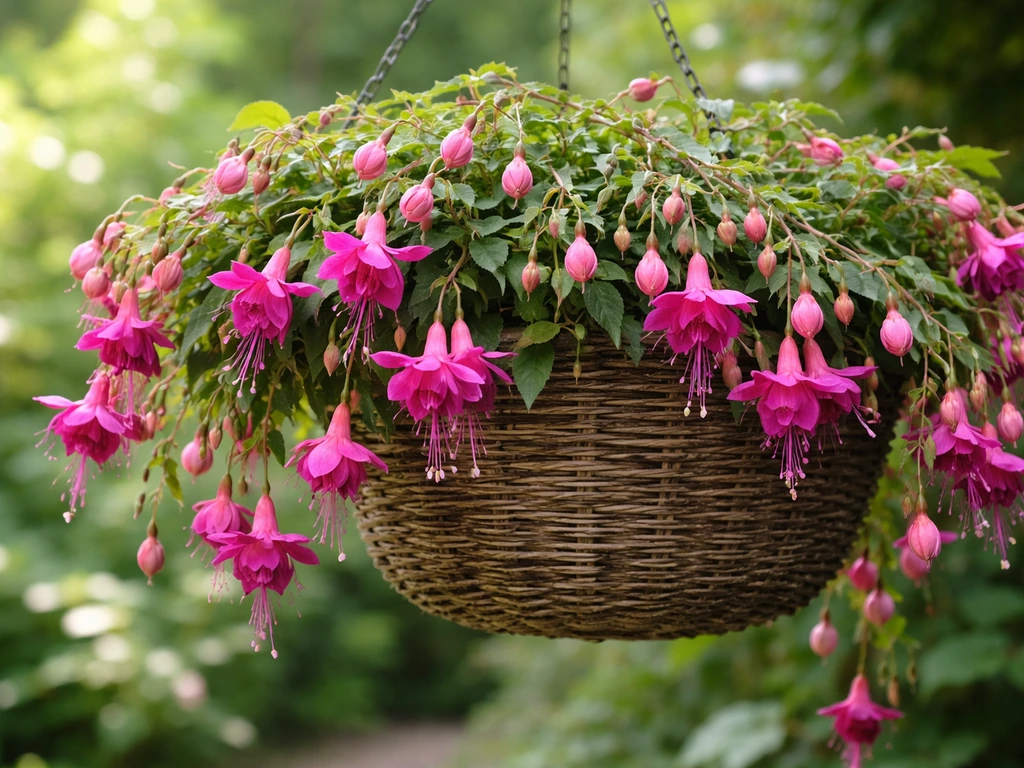
Choosing the right fuchsia variety for hanging baskets

Not all fuchsias hang. There are upright shrub types bred for beds and pots, and then there are trailing or semi-trailing types specifically suited to baskets. For a hanging basket, you want the trailing types, their stems naturally arc and drape over the edge, which is the whole point of the display.
Some of the most reliable trailing varieties include 'Swingtime' (red and white double flowers, vigorous and forgiving), 'Dollar Princess' (compact, free-flowering in purple and cerise), 'Cascade' (long pendant flowers in white and deep pink), and 'Marinka' (single red, incredibly floriferous). If you want something a little different, 'Gartenmeister Bonstedt' is a more heat-tolerant species hybrid, useful if you live somewhere summers push past 85°F regularly. Most standard trailing fuchsias genuinely struggle once temperatures climb above 80°F for extended periods, so knowing your climate before you pick your variety matters.
A quick rule of thumb: if a label says 'trailing,' 'basket,' or 'pendula,' you're looking at the right type. If it just says 'upright' or gives a height without mentioning trailing habit, put it back and keep looking.
Best planting time and setup
When to plant
The best time to plant a fuchsia hanging basket is in spring, once nighttime temperatures are reliably staying above 45°F and frost risk is past. In most temperate zones that means somewhere between late March and mid-May. If you're starting early indoors (which gives you a bigger plant by the time it goes outside), you can pot up fuchsias 6 to 8 weeks before your last frost date and keep them in a cool, bright room or greenhouse until conditions outside are suitable.
Container size and drainage
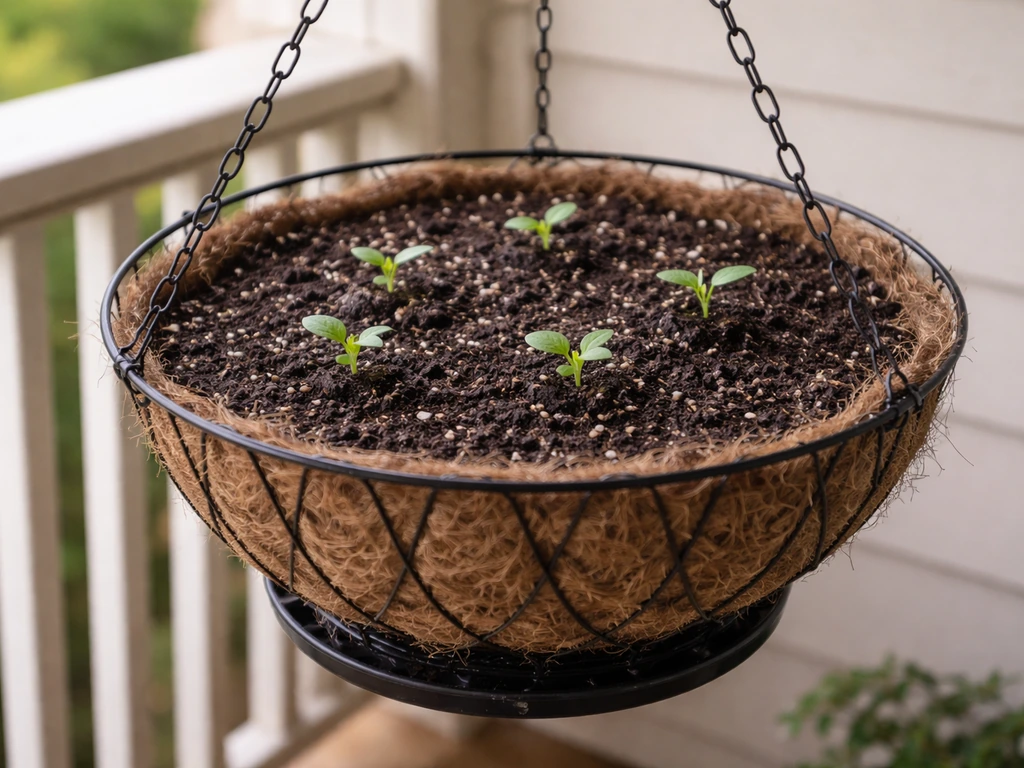
For a basket that actually looks full and lush, you want a container at least 12 inches in diameter, though 14 to 16 inches is better if you're planting 3 to 5 starts. The basket needs good drainage, this is non-negotiable. Fuchsias sitting in waterlogged soil will rot at the roots. Wire baskets lined with coco fiber or moss work beautifully because they drain freely from all sides, but any basket with adequate drainage holes at the bottom works too. If you're using a solid plastic basket, make sure the drainage holes aren't small or few, you want water to move through freely, not pool.
The right potting mix
Use a high-quality potting mix that is light, friable, and rich in organic matter. The American Fuchsia Society specifically recommends a mix that is 'good light friable mix rich in humus' and warns that a mix that plugs drainage holes can effectively drown the plant. I add perlite to a standard all-purpose potting mix at roughly a 20 to 25 percent ratio by volume, this keeps the mix airy and improves drainage without sacrificing moisture retention. Do not use garden soil in a hanging basket; it compacts, drains poorly, and will suffocate roots.
How to plant fuchsias in hanging baskets
Starting from nursery transplants (the practical route)
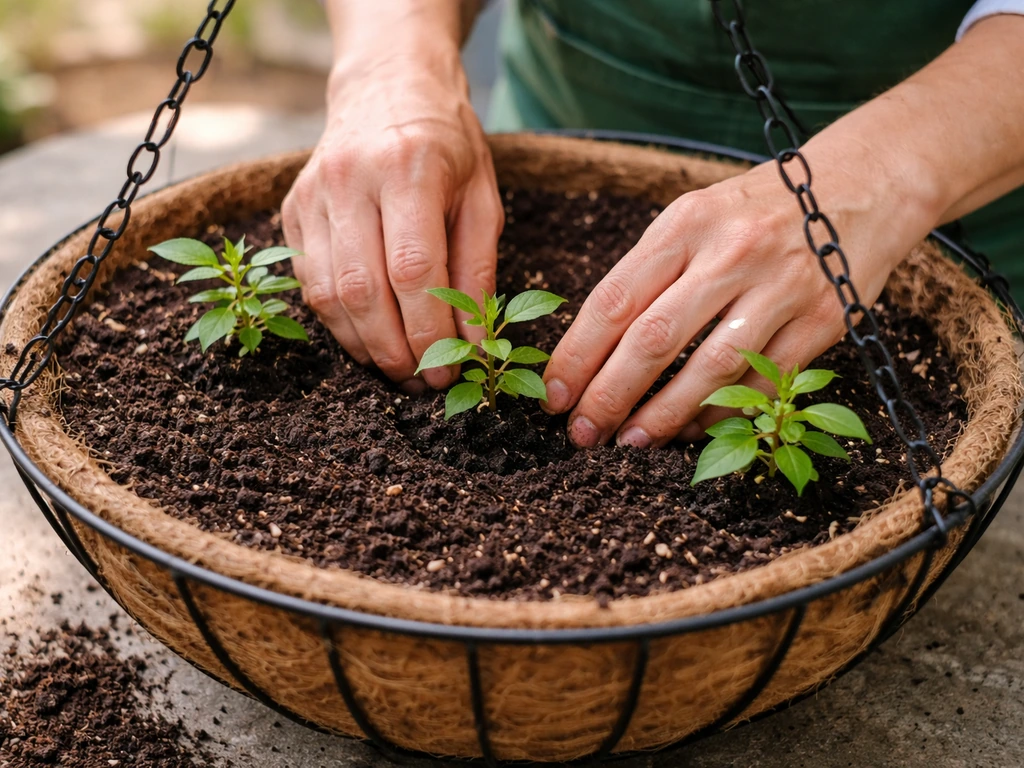
Most gardeners, even experienced ones, buy nursery starts rather than growing fuchsias from seed, and for good reason: fuchsia seeds are slow, temperamental, and the best trailing varieties are hybrids that don't come true from seed anyway. Buying healthy 3 to 4 inch starts in spring gets you to a blooming basket weeks faster.
When planting, WSU Clark County Extension recommends positioning 3 to 5 starts in the basket about halfway between the center and the edge, not crammed into the middle, and not pushed to the rim. This spacing encourages each plant to have room to develop and trail over the sides evenly. Fill around the rootballs with your potting mix, firm gently, and water thoroughly until water runs freely from the drainage holes. Leave about half an inch of space at the top of the basket so water doesn't run straight over the edge before it soaks in.
Growing from seed (if you want the challenge)
If you want to try fuchsias from seed, start them indoors 12 to 16 weeks before your last frost date. Surface-sow seeds on moist seed-starting mix, barely cover them, and keep them at around 70 to 75°F with consistent moisture. Germination can take 3 to 4 weeks and is often uneven. Seedlings need bright indirect light once they sprout. Be realistic: growing trailing fuchsias from seed is a long-game project, and you're unlikely to get the same free-flowering performance you'd get from a named cutting-grown variety. For most people, seeds are an experiment, not the primary strategy.
Watering, feeding, and sun/shade care for nonstop blooms
Light: shade is your friend
Fuchsias are not sun lovers. They perform best in partial to full shade, particularly in the afternoon. A spot with morning sun and afternoon shade is ideal. Full sun bakes them, stresses the roots, and causes rapid flower drop.
If you're in a cooler climate (Pacific Northwest, coastal regions, northern UK-style conditions), you can get away with more sun exposure. But in most of the continental US, a shaded porch or pergola is where fuchsia baskets thrive. This is actually one of their best qualities as a garden plant: they fill shady spots that many flowering plants can't handle.
Shade loving, nonstop bloomers like fuchsias can be easier to manage when you compare care with other container flowers, for example see how to grow impatiens in hanging baskets for another similar approach to shade and frequent watering.
Temperature
Fuchsias are genuinely sensitive to temperature. They prefer daytime temperatures between 60 and 70°F and do well with cooler nights, a 10°F night-to-day differential actually encourages strong growth. Once temps consistently push into the mid-80s and above, you'll see fewer flowers, more heat stress, and occasional wilting even in well-watered plants. If summer heats up significantly in your area, moving baskets to a cooler, shadier location mid-season can bring them back to blooming once temps moderate.
Watering
Watering is the biggest variable in hanging basket success, and fuchsias are unforgiving in both directions. The potting mix should stay moist but never waterlogged. Iowa State University Extension recommends watering until water flows freely from the bottom, this ensures the entire root zone is hydrated, not just the top inch. In hot weather, a basket in bloom can need watering once or even twice daily. In cooler, overcast conditions, every two to three days may be enough. The practical test: push your finger an inch into the soil. If it feels dry at that depth, water. If it feels moist, wait.
Feeding
Fuchsias are heavy feeders, and because hanging baskets are watered so frequently, nutrients flush out of the mix quickly. During the active growing season, feed every 7 to 14 days with a balanced liquid fertilizer (something like a 20-20-20 or a bloom-booster with higher phosphorus like 15-30-15).
If you’re also wondering how to grow portulaca in hanging baskets, the key is matching sun and watering needs to keep the plants compact and flowering feed every 7 to 14 days with a balanced liquid fertilizer. I tend to use a higher-phosphorus feed once the plants are well-established and starting to bud, since phosphorus supports flower production. Start feeding about two weeks after planting and keep it up consistently through summer.
Skipping feeds is one of the most common reasons fuchsia baskets stop blooming mid-season.
Pruning, pinching, and training for trailing growth
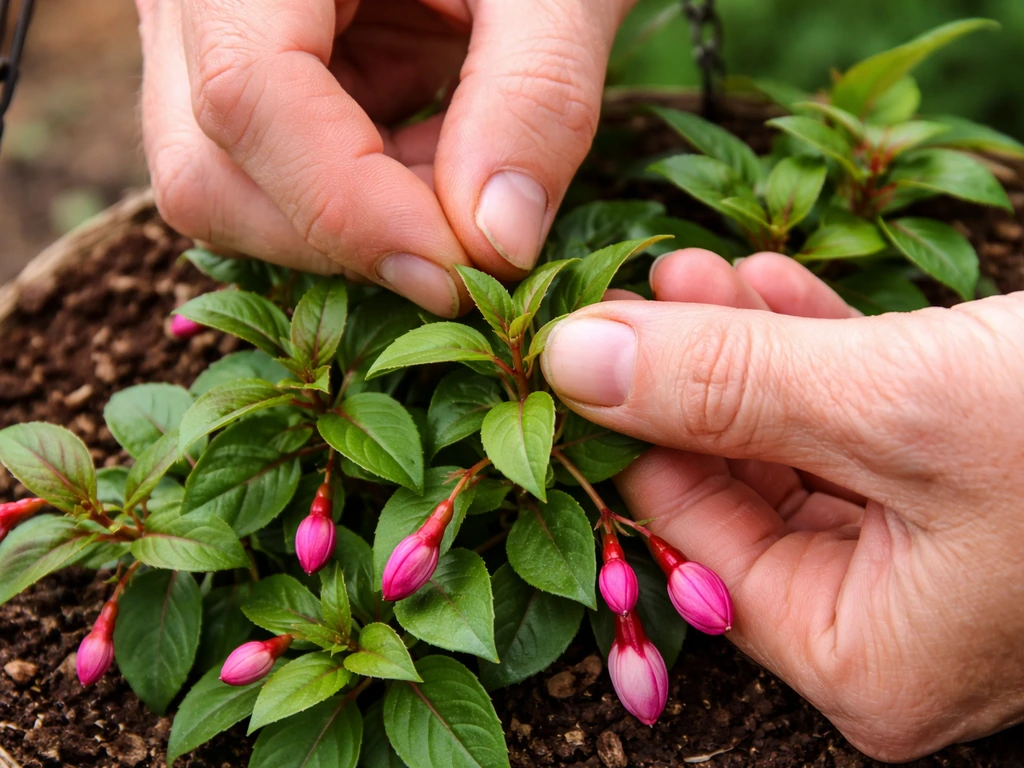
Pinching is the single most important technique for getting a full, bushy basket instead of a few long, sparse stems. When you first plant your starts, pinch out the growing tip of each stem, this forces the plant to branch rather than just grow straight down. Each pinch point creates two new stems, which means more branching and ultimately more flowers. WSU recommends pinching immediately after planting to encourage this from the start.
For the first few weeks, continue pinching back any new growth that's getting leggy or outpacing the rest of the plant. Once the basket has filled in and you're seeing flower buds forming, ease off the pinching, you don't want to keep removing the tips where buds develop. A good rule is to stop hard pinching about 6 to 8 weeks before you want peak bloom.
Throughout the summer, deadheading spent flowers (removing the faded bloom plus the small swelling behind it, which is the developing seed pod) keeps the plant focused on producing more flowers rather than setting seed. This is sometimes called 'grooming' the basket and makes a noticeable difference in how continuously the plant blooms.
Pests, diseases, and common problems
Common pests
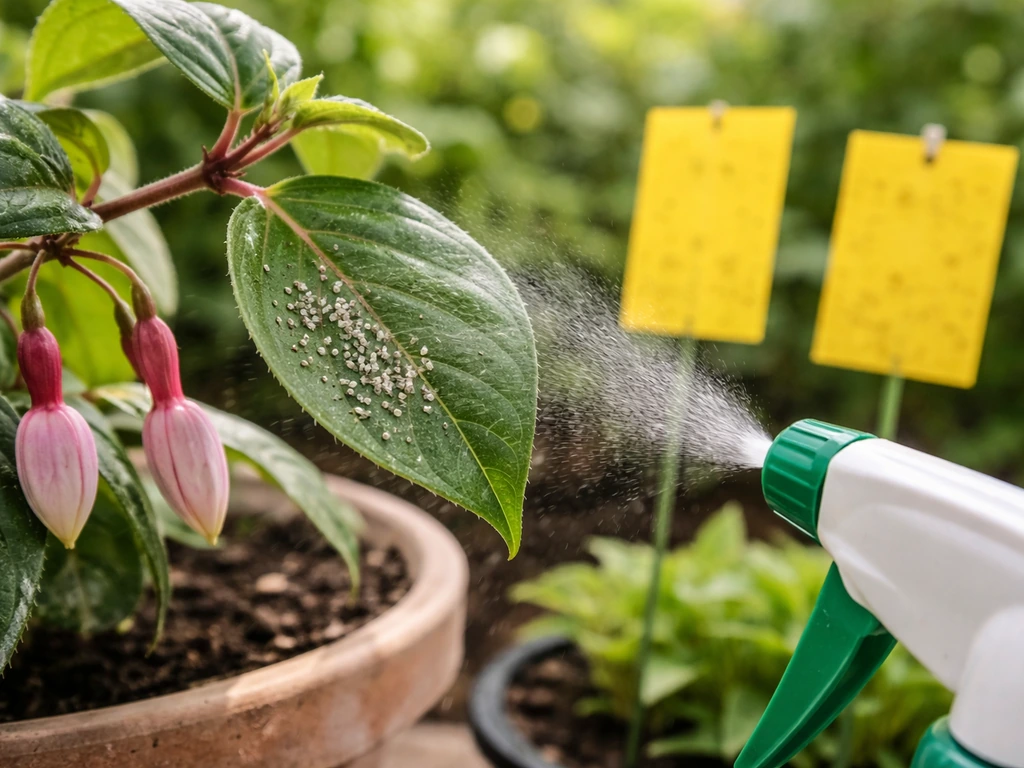
| Problem | Symptoms | Fix |
|---|---|---|
| Whitefly | Tiny white insects under leaves, sticky residue, yellowing | Insecticidal soap spray, yellow sticky traps, neem oil |
| Fuchsia gall mite | Distorted, puckered new growth, no flowers from affected stems | Remove all affected growth immediately, apply miticide, discard badly affected plants |
| Aphids | Clustered soft insects on new growth, sticky leaves | Strong water spray, insecticidal soap, introduce ladybugs |
| Vine weevil | Notched leaf margins, wilting despite watering (larvae eat roots) | Biological nematode treatment in soil, check roots, repot if badly damaged |
| Spider mites | Fine webbing, stippled/bronzed leaves in hot dry conditions | Increase humidity, mist regularly, use miticide or insecticidal soap |
Common diseases and growing problems
- Botrytis (gray mold): Fuzzy gray growth on stems or flowers, usually from poor air circulation or overwatering. Remove affected parts, improve airflow, reduce overhead watering, and apply a fungicide if severe.
- Root rot: Plants wilt despite moist soil, stems feel soft at the base. Caused by waterlogged conditions. Check that drainage holes aren't blocked, allow the mix to dry slightly between waterings, and repot with fresh mix if roots are black and mushy.
- Wilting despite watering: Can mean heat stress rather than dehydration. Move the basket to a cooler, shadier spot and the plant usually recovers within a day.
- Failure to bloom: Usually caused by too much nitrogen (pushes leafy growth at the expense of flowers), insufficient light, heat stress, or stopping the feeding schedule. Switch to a higher-phosphorus fertilizer and reassess light and temperature conditions.
- Leggy, sparse stems: Caused by insufficient pinching early on or too little light. Cut back leggy stems by a third, pinch growing tips, and move to slightly brighter indirect light.
Winter care and getting back to blooming next season
Fuchsias are tender perennials, which means they can survive winter if you protect them from frost, but they won't survive outdoors in most temperate climates without some help. In USDA zones 9 to 11, trailing fuchsias can sometimes stay outside year-round with minimal protection. In zones 6 to 8, overwintering indoors is the reliable approach. In zone 5 and below, treat them as annuals or commit to bringing them inside.
To overwinter a fuchsia basket: before the first frost, bring the basket inside and cut the plant back by about half. Move it to a cool, frost-free space, a garage, basement, or unheated spare room that stays between 40 and 50°F is ideal. Water only sparingly through winter, just enough to prevent the roots from completely drying out (roughly every 3 to 4 weeks). The plant will go semi-dormant and lose most of its leaves. This is normal. Do not fertilize during dormancy.
In late winter or very early spring (February or March depending on your climate), bring the basket into a warmer, brighter location, a sunny windowsill or a cool greenhouse works well. Begin watering more regularly as you see new growth emerging, and once the plant has several inches of new growth, start your regular feeding schedule again. Pinch back the new growth to encourage branching, just as you would when planting fresh. Your overwintered fuchsia should be back in bloom by late spring, usually earlier and more robustly than a newly purchased plant.
If you're also growing other shade-loving flowering plants in baskets alongside fuchsias, it's worth knowing that plants like impatiens and New Guinea impatiens share similar light preferences and can be paired with fuchsias in a shady display. Ferns are another natural companion for shaded baskets given their love of similar conditions. If you want to grow ferns in hanging baskets too, aim for stable shade, evenly moist soil, and gentle weekly feeding to keep them lush Fern hanging baskets. Each has its own specific care requirements, but the underlying principle of consistent moisture, shade, and regular feeding connects them all.
The honest truth about fuchsia baskets is that they reward attention. They're not the most low-maintenance plant, but the payoff, a fully dripping cascade of those distinctive pendant flowers in colors that seem almost too vivid to be real, is worth every watering can refill. Get the variety right, don't overcook them in sun or heat, and keep up with feeding and pinching, and you'll have a basket that genuinely stops people in their tracks.
FAQ
Can I grow trailing fuchsia in full sun if I water a lot?
Yes, but choose your variety carefully and treat it as a controlled experiment. Look for trailing types labeled for baskets or pendula, and give them morning sun only. If your area routinely hits the mid to high 80s, move the basket to the coolest, shadiest spot you have during heat waves, and expect fewer blooms unless you can improve airflow and keep the root zone consistently moist.
What basket size is ideal, and does pot depth matter?
Many people overpot or underpot, both can reduce flowering. For best results, aim for a basket about 12 inches wide or larger, and avoid letting the plant rootball sit too deep in the mix. Also, keep the top water space (about half an inch) so water soaks in rather than spilling over the rim.
How do I know I’m watering deeply enough, not just soaking the surface?
If water runs freely from the drainage holes, you are hydrating the whole root zone. If it mostly runs out quickly, the mix may be compacted, too dry, or hydrophobic. In that case, soak the basket longer, and if it repeatedly fails, repot into a lighter, friable mix with added perlite (about 20 to 25% by volume).
Can I use a liner inside a hanging basket to help retain moisture?
Drainage is the priority, so avoid decorative liners that trap water. If you use a liner, make sure it does not block drainage holes, and consider breathable coco fiber or moss liners instead of airtight plastic. Never leave the basket standing in a saucer of runoff.
My fuchsia basket has lots of leaves but not many flowers. What’s the first thing to check?
Overfertilizing is a common way to get lots of leaves but fewer blooms. Use the same feeding intervals, but don’t increase strength beyond label directions. If your basket is lush but bud production stalls, switch to a bloom-leaning fertilizer for several weeks and ensure you are pinching early in the season.
When should I stop pinching to avoid reducing flowering?
Pinching timing matters. Pinch right after planting, then stop hard pinching about 6 to 8 weeks before you want peak bloom so you do not remove developing buds. After buds form, you can still lightly tidy leggy shoots, but avoid repeated deep tip removal.
What exactly should I remove when deadheading fuchsia flowers?
Deadheading should remove the spent flower and the seed pod swelling behind it. If you only cut off the petals and leave the swollen base, the plant may still divert energy to seed. Regular “grooming” also helps maintain an even, full look as the basket fills in.
Why does my fuchsia wilt in hot weather even though I watered?
Yes, fuchsia baskets can wilt in heat even when soil seems moist, especially if the root zone is not getting air. Check whether the mix stays light, not dense, and whether drainage is adequate. Improve airflow, move to afternoon shade, and consider repotting if the mix has turned heavy or waterlogged over time.
Can I overwinter a fuchsia cutting or should I overwinter the entire hanging basket?
Fuchsia cuttings can be overwintered if you bring them indoors early and keep them cool and frost-free, but baskets are harder because the plant is larger and the mix holds water longer. If you want to save a basket plant, follow the overwinter steps for the whole basket (cut back by about half, cool space around 40 to 50°F, minimal winter watering).
What causes fuchsia baskets to stop blooming mid-season?
If your basket’s performance drops suddenly, check three things in order: (1) temperature and afternoon exposure, (2) watering depth (finger test and full soak), and (3) fertilizer schedule, since nutrients flush quickly. Also look for root issues from soggy mix, then adjust before you increase fertilizer.
How should I space multiple fuchsia starts in one basket?
Start with 3 to 5 starts and place them halfway between the center and edge, spaced so their trails can flow over the rim naturally. If you cram them into the middle, you often get crowded stems that take longer to fill and can trap moisture. If you leave them too close to the rim, stems may sprawl and break.
Can I fertilize with slow-release granules instead of liquid feed?
Yes, but use the right fertilizer format and frequency. For hanging baskets, liquid feeds at 7 to 14 day intervals are easiest to keep consistent, and you should start about two weeks after planting. If you use slow-release pellets, they can be uneven in small volumes, so you may still need light supplemental feeding later in summer.
What pests should I watch for on fuchsia baskets, and what’s the best first response?
Common pests in outdoor containers include aphids and whiteflies, and stress from heat and inconsistent watering makes issues worse. Use an early intervention approach, rinse foliage with water, and treat with an appropriate insecticidal soap if needed. Avoid heavy nitrogen-only feeding when pest pressure is high, since it encourages tender growth.
Next Article
How to Grow New Guinea Impatiens From Seed to Bloom
Step-by-step guide to grow New Guinea impatiens from seed to bloom: sowing, germination, care, transplanting, troublesho
