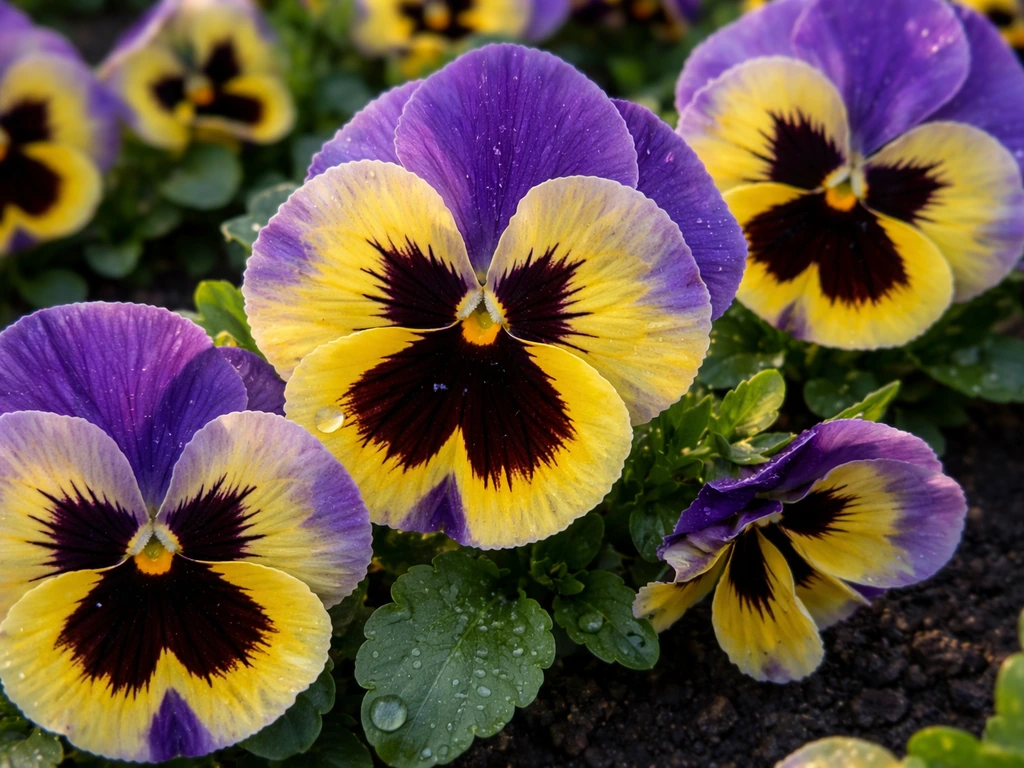
To grow purple mums in Animal Crossing: New Horizons, plant two White mum seeds next to each other in a checkerboard layout, water them every day, and you have roughly a 25% chance per eligible pair of getting a purple mum to spawn in an adjacent empty tile. That is the most straightforward route, and if you have never bred flowers before, it is the one to start with. The whole process takes anywhere from a few in-game days to a couple of weeks depending on luck and how many visitors you can get to water your farm.
How to Grow Purple Mums in Animal Crossing: Complete Guide

Harriet Whitmore
17 Jul 2026
What this guide covers
I put this guide together after spending way too many in-game mornings checking my mum patches and finding nothing but clones. There is a lot of conflicting information out there, especially older guides written for New Leaf that do not apply to New Horizons mechanics. What you will find here is specific to ACNH: exact parent-color combinations, planting layouts that actually leave room for offspring to spawn, a daily care routine, a 7-day action plan, a sample farm layout you can copy, and troubleshooting for the most common reasons hybrids simply refuse to show up. If you are also working on pansies, the mechanics below carry over well, so keep that in mind as you read.
How flower breeding actually works in ACNH
ACNH uses a hidden genotype system under the hood. Every flower carries genes that determine not just its color but what offspring it can produce. The color you see is a phenotype, and two flowers that look identical can have different genotypes and produce completely different results. This matters enormously for mums, because there are two visually identical purple mums in the game that behave very differently as parents.
Each day, a flower that was watered (by you, a visitor, or rain) and has at least one flower of the same species adjacent to it (orthogonally or diagonally) gets one attempt to produce offspring. The new flower spawns in any empty tile within the 3x3 area surrounding the parent. If there is no empty tile nearby, or if no eligible partner is adjacent, the flower may produce a clone of itself instead. That cloning behavior is one of the main reasons breeding farms stall out: too many plants, not enough open spawn tiles.
The base chance for a hybrid to appear from an eligible pair is low, commonly estimated around 5% per eligible pairing per day. That sounds discouraging but stacks up quickly when you have multiple pairs running simultaneously and visitors come by to water. Rain also counts as watering, so rainy days are effectively free progress days.
What you need before you start
Starter mum sources
The safest and most reliable parents for purple mums are seed-bag White mums and seed-bag Yellow mums purchased directly from Nook's Cranny. Seed-bag flowers have clean, known genotypes, which is exactly what you want. Flowers picked up from mystery islands or gifted by villagers can carry hybrid genotypes that look identical to seed colors but behave differently in breeding chains. Unless you are deliberately working with confirmed hybrid parents, always start your farm with freshly purchased seed-bag flowers.
- Nook's Cranny: rotating seed-bag stock includes Red, White, and Yellow mums; check daily as stock refreshes
- Leif: the outdoor vendor occasionally carries seed bags for flower types not currently stocked at Nook's Cranny; worth checking every visit
- Mystery Tour islands (Nook Miles Tickets): islands sometimes have native flowers including hybrid mums, but treat these as unverified genotypes unless you are cross-referencing a datamine table
- Friends and online visitors: players can drop or trade confirmed hybrid mums, which is the fastest way to jumpstart an advanced chain without breeding from scratch
Tools and plot space
You do not need any special tools to breed mums. A standard watering can works fine. The Golden Watering Can has a wider watering radius and leaves a sparkle effect, but it does not guarantee hybrids or meaningfully change the breeding probability for mums. Save the golden can effort for gold roses if that is something you want later. For plot space, a 5x5 or 6x6 cleared area is plenty to run an efficient small farm. You will also want a handful of path tiles, custom designs, or fencing to mark your original parents so you do not accidentally dig them up later.
The exact parent combinations that produce purple mums
This is the part most players get wrong because they mix up the two types of purple mums. Here are the confirmed combinations based on the ACNH datamine genetics tables:
| Parent 1 | Parent 2 | Result | Purple Type | Can Breed Green Mums? |
|---|---|---|---|---|
| White (seed bag) | White (seed bag) | Purple (~25% chance) | Seed Purple | No |
| Hybrid Yellow | Hybrid Yellow | Hybrid Purple (~6.25% chance) | Hybrid Purple | Yes |
| Purple (seed) | Purple (seed) | Various outcomes including more Purple | Seed Purple | No |
The key distinction: the purple mum you get from two White seed-bag parents looks exactly the same as the hybrid purple you get from two Hybrid Yellow parents, but they are genetically different flowers. Only the Hybrid Purple (from the Hybrid Yellow x Hybrid Yellow pairing) can eventually be used in the chain that produces Green mums. Purple mums, New Horizons HQ (parent combos and hybrid notes) summarizes the exact parent‑color recipes: White + White → Purple (seed‑white pair produces purple) and Hybrid Yellow + Hybrid Yellow → Hybrid Purple (hybrid lineage required to progress to Green mums) Purple mums — New Horizons HQ (parent combos and hybrid notes). If your goal is just to collect purple mums for decoration or trades, the White x White route is faster and simpler. If you are building toward green mums down the line, you need to go through the Hybrid Yellow path.
How to get Hybrid Yellow mums
Hybrid Yellow mums come from pairing Red seed mums with White seed mums. The offspring are Yellow in color but carry a hybrid genotype. Once you have confirmed Hybrid Yellows (bred from clean seed-bag Red and White parents), pairing two of them together gives you a chance at the Hybrid Purple that can later make Green mums.
Planting patterns, adjacency rules, and spacing
Adjacency in ACNH includes both orthogonal (up, down, left, right) and diagonal tiles, meaning every flower in a checkerboard pattern is adjacent to its neighbors. The rule you need to remember is: a parent needs at least one same-species neighbor AND at least one empty tile in its 3x3 surrounding for offspring to spawn. Block both of those conditions and nothing will happen.
Checkerboard layout (beginner-friendly)
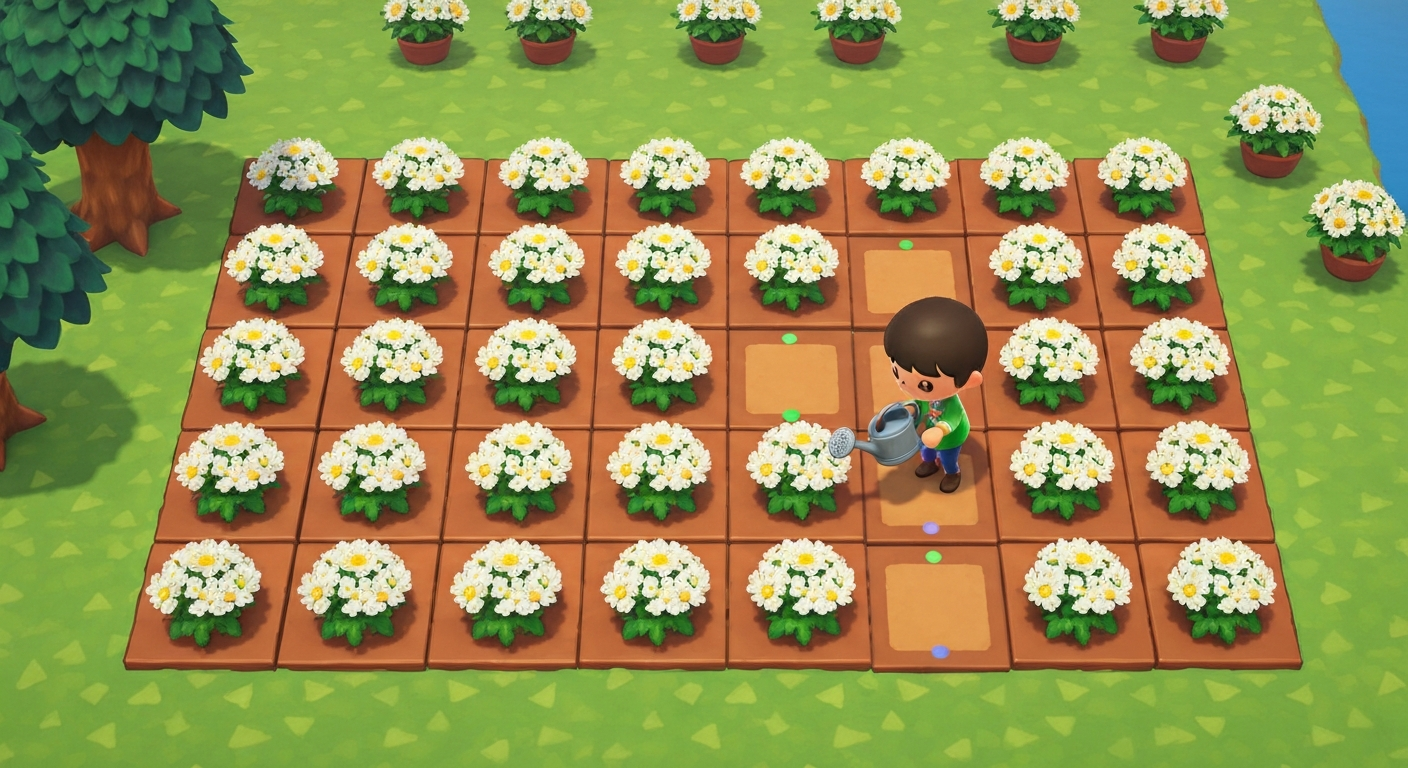
The standard checkerboard alternates parent flowers with empty tiles. Every flower is adjacent to its intended partner, and every flower has open tiles where offspring can appear. This is the easiest layout to set up and maintain, and it works reliably for the White x White purple mum route.
| Col 1 | Col 2 | Col 3 | Col 4 | Col 5 |
|---|---|---|---|---|
| W | . | W | . | W |
| . | . | . | . | . |
| W | . | W | . | W |
| . | . | . | . | . |
| W | . | W | . | W |
In the table above, W = White seed mum and . = empty tile. Each White mum is diagonally adjacent to its neighbors, satisfying the adjacency requirement, and every W tile has empty space around it for a purple mum to spawn. When a purple appears in a dot tile, remove it promptly and replant a White seed parent in its place to keep the farm running efficiently.
Isolated pairs layout (more controlled)
If you want to avoid any accidental cross-pairing between flowers of different genotypes, plant your parents in isolated pairs with a gap of at least two tiles between each pair. This is slower because you have fewer active pairs, but it keeps your breeding chains clean, which matters once you start working with hybrid parents.
| Col 1 | Col 2 | Col 3 | Col 4 | Col 5 | Col 6 | Col 7 |
|---|---|---|---|---|---|---|
| W | W | . | . | W | W | . |
| . | . | . | . | . | . | . |
| . | . | . | . | . | . | . |
| W | W | . | . | W | W | . |
Here each W pair is orthogonally adjacent (side by side) with two empty rows separating each pair from the next. Spawn tiles appear above, below, and beside the pair. This layout is especially useful when working with the Hybrid Yellow x Hybrid Yellow step because you want to make absolutely sure those yellows are only pairing with each other.
Daily actions that increase your hybrid rate
The single most impactful thing you can do every day is water every mum in your breeding farm. Rain counts automatically, so on rainy in-game days you can skip manual watering and still make progress. But on dry days, if you forget to water, those flowers are ineligible to breed the following morning. I learned this the hard way after three days of nothing and eventually realized I had been skipping the back row.
Visitor watering is genuinely powerful. When other players visit your island and water your flowers, the game stacks additional breed attempts. Multiple visitors watering the same day increase spawn attempts, the Hybrid Flower Guide, GameFAQs (visitor watering / stacking summary) documents community tests showing progressive stacking and noticeably higher daily hybrid yields with 1–5+ visitors Hybrid Flower Guide — GameFAQs (visitor watering / stacking summary). Community testing shows that having multiple visitors water your farm on the same day meaningfully increases the number of new flowers that spawn the next morning. If you have friends who play ACNH or are active in online communities (Discord servers, Reddit), ask them to swing by and water. Even one or two visitors makes a noticeable difference over a week.
- Water every parent flower daily with any watering can (rain counts automatically)
- Invite 1 to 5 online visitors to water your farm on the same day for stacked spawn attempts
- Remove any clone or unwanted offspring the same day you find them to keep spawn tiles open
- Do not walk through your breeding grid repeatedly; trampling flowers does not destroy them but keeping foot traffic minimal reduces the risk of accidentally moving or digging up parents
- Replace removed parents promptly with fresh seed-bag flowers to maintain the same number of active pairs
Sample breeding farm layouts and templates
Small farm: 5x5 checkerboard (9 active pairs)
This is the layout I recommend for players just starting out. It fits easily on any flat area of your island, uses 9 White seed mums, and gives you plenty of open spawn tiles for purple mums to appear. The whole thing takes about 30 seconds to water each day.
| Col 1 | Col 2 | Col 3 | Col 4 | Col 5 |
|---|---|---|---|---|
| W | . | W | . | W |
| . | . | . | . | . |
| W | . | W | . | W |
| . | . | . | . | . |
| W | . | W | . | W |
Medium farm: 6x6 grid (18 active White parents)
Scale up to an 18-parent layout once you are comfortable with the routine. This doubles your active pairs and typically produces 2 to 4 new purple mums per week under good watering conditions. Use path tiles or fencing around the perimeter so spawn tiles are bounded and you can spot new offspring easily.
| Col 1 | Col 2 | Col 3 | Col 4 | Col 5 | Col 6 |
|---|---|---|---|---|---|
| W | . | W | . | W | . |
| . | . | . | . | . | . |
| W | . | W | . | W | . |
| . | . | . | . | . | . |
| W | . | W | . | W | . |
| . | . | . | . | . | . |
Hybrid Yellow to Hybrid Purple chain layout
For the advanced chain that eventually yields green mums, keep your Hybrid Yellow parents in a completely separate fenced-off zone away from your White x White farm. Label the area with a custom design sign if you can. Use the isolated pairs layout from the adjacency section above, and only move confirmed Hybrid Yellows (bred from seed Red + seed White parents you tracked yourself) into this zone.
| Col 1 | Col 2 | Col 3 | Col 4 | Col 5 | Col 6 |
|---|---|---|---|---|---|
| HY | HY | . | . | HY | HY |
| . | . | . | . | . | . |
| . | . | . | . | . | . |
| HY | HY | . | . | HY | HY |
In this template, HY = confirmed Hybrid Yellow mum and . = empty spawn tile. Keep a physical note or in-game custom design label showing which pair is which so you do not mix them up with any seed Yellows you might have elsewhere on your island.
Your 7-day planting and care plan
Follow this checklist from Day 1 and you will have your first purple mums within the first week in most cases. Results vary based on luck and visitor watering, but this routine covers everything within your control.
- Day 1: Purchase at least 9 White mum seed bags from Nook's Cranny (buy extras in case you need replacements). Clear and flatten a 5x5 plot. Plant in the checkerboard pattern shown above. Water all 9 flowers.
- Day 2: Water all parents. Check for new spawns (unlikely this early but possible). If you find any clones (White mums in spawn tiles), dig them up and keep the tile empty. Invite at least one friend to visit and water if you can.
- Day 3: Water all parents. Remove any clones in spawn tiles immediately. If it rained overnight, your plants were automatically watered — check for new flowers but do not skip your own watering for the following day.
- Day 4: Water all parents. By now you should have at least one purple mum if you have had any visitors water. Move any purple mums that have appeared to a separate holding area — do not replant them in the breeding farm yet until you decide what to do with them.
- Day 5: Water all parents. Invite visitors to water again if possible (stacking two or more visitors in the same day is particularly effective). Replace any parent spots left empty by moved or removed flowers with fresh White seed-bag mums.
- Day 6: Water all parents. Do a full audit of your grid: every W position should have a White seed mum, every dot position should be empty or contain a new spawn you are about to remove. Tidy the farm and keep tiles open.
- Day 7: Water all parents. By the end of day 7, most players running a 9-parent checkerboard with some visitor watering will have at least 2 to 5 purple mums. Continue the same routine — the farm keeps running indefinitely as long as you water and clear spawn tiles daily.
Seasonal availability and best times to breed on your island
Here is some good news: the underlying breeding mechanics in ACNH do not depend on the real-world season or your island's hemisphere. Mum seed bags are available at Nook's Cranny year-round as part of the rotating daily stock, so you are never locked out of starting a mum farm based on the calendar. Unlike some wild flowers that only spawn on your island during certain months, the breeding process itself runs any time you plant, water, and maintain your farm.
That said, the practical best time to start is whenever you have consistent daily playtime to water and check the farm. A breeding farm that goes unwatered for several days loses momentum and can fill with clones that block spawn tiles. If you know you are going into a period of lower playtime, either pause the farm (dig up parents and store them) or ask a trusted friend to check in on it. For players in the Northern Hemisphere playing in real-world autumn (when chrysanthemums are in season outdoors), there is a nice poetic alignment there, though it does not affect in-game probabilities at all.
Why your purple mums are not showing up (and how to fix it)
I have been through every one of these failures myself, and I have seen all of them come up repeatedly in player communities. If you are following the plan and still not seeing purple mums after a week, one of the following is almost certainly the cause.
| Problem | Why It Happens | Fix |
|---|---|---|
| No new flowers at all | Parents were not watered the previous day | Water every single parent flower each day without exception; check rain status before skipping |
| Only clones appearing (White mums in spawn tiles) | No empty tiles adjacent to parents for hybrid offspring to occupy | Clear all spawn tiles daily; remove clones the same day they appear |
| Parents disappearing | You accidentally dug up a seed parent instead of a clone | Mark original parents with path tiles, custom designs, or fencing; never dig in the grid without checking |
| Purple mums appearing but then stopping | Spawn tiles are filling up and parents are crowded out | Maintain a strict clear-spawn-tile routine every single day |
| Getting purples but they do not breed green mums later | You have seed purples (White x White), not hybrid purples (Hybrid Yellow x Hybrid Yellow) | Start the Hybrid Yellow chain from scratch using seed Red + seed White parents to generate confirmed Hybrid Yellows |
| Very low yield even with correct setup | No visitors watering your farm | Actively recruit friends or community members to visit and water; even one visitor noticeably boosts results |
| Using mystery island or gifted mums as parents | These flowers may have unknown hybrid genotypes that produce unexpected results | Replace with fresh seed-bag White mums purchased from Nook's Cranny |
One mistake I see constantly is players using flowers they found on mystery islands as breeding parents without verifying the genotype. A white-colored mum from a mystery island can look identical to a seed White but carry a hybrid genotype that cross-breeds with your seed Whites to produce off-chain offspring. If your results look random or inconsistent, swap out mystery island parents for confirmed seed-bag flowers and start fresh.
Advanced tips: building your purple mum stock faster
Protecting and moving confirmed hybrids
Once you have purple mums you want to keep, store them in a dedicated holding zone well away from your breeding grid. Mums can be moved with a shovel without damaging them; dig carefully, place them in the holding zone, and use path tiles or fencing to mark the area. Never put hybrid purples back in the main breeding grid unless you are intentionally using them as parents in the next chain step.
The friend-trading shortcut
If you are trying to build a large stock of purple mums quickly for decoration or trading, the fastest method is combining your own farm output with flowers received from friends or online trades. ACNH Discord servers and Reddit communities (r/ACNHTrades, r/NoFeeAC) regularly have players offering confirmed hybrid mums for bells, Nook Miles Tickets, or just as giveaways. Getting even 4 to 6 confirmed hybrid purples from a trade immediately gives you a second active breeding farm with zero wait time for the first-generation cross.
Maximizing visitor watering systematically
Community testing shows that 5 visitors watering your flowers on the same day produces a noticeably higher spawn rate the following morning than a single player watering alone. To take advantage of this, post your Dodo Code in an ACNH community on a day when you have good hybrid parents set up and your spawn tiles are clear. Let visitors water and leave. Check your farm the next morning for the results. Combining a high-visitor day with a freshly cleared grid is the single most efficient use of one in-game day in the entire breeding process.
Tracking your genotype chains
For the Hybrid Yellow path, keep a running note (even a sticky note next to your gaming setup) that tracks: which plants are seed-bag Red parents, which are seed-bag White parents, which confirmed Hybrid Yellows came from that pairing, and which confirmed Hybrid Purples came from the Hybrid Yellow step. The moment you lose track of which generation a plant came from, the chain breaks down. It sounds tedious but takes about 30 seconds to update each time a new hybrid generation is confirmed.
Printable checklist and copy-ready planting template
Use the table below as a daily reference you can print or screenshot. Check off each item as you complete it each in-game day.
| Daily Task | Done? |
|---|---|
| Water all parent mums in breeding grid (or confirm rain watered them) | [ ] |
| Check all spawn tiles for new flowers | [ ] |
| Remove any clones (same-color copies of parents) from spawn tiles | [ ] |
| Move any purple mums to holding zone | [ ] |
| Replace any empty parent spots with fresh seed-bag White mums | [ ] |
| Invite at least one visitor to water (message friends or post Dodo Code) | [ ] |
| Confirm all original parent markers (path tiles / fencing) are intact | [ ] |
And here is the quick-reference copy-ready planting template for the 5x5 beginner farm. W = White seed mum, . = empty spawn tile. Print it, screenshot it, or paste it into a notes app on your phone for reference while playing.
| Col 1 | Col 2 | Col 3 | Col 4 | Col 5 |
|---|---|---|---|---|
| W | . | W | . | W |
| . | . | . | . | . |
| W | . | W | . | W |
| . | . | . | . | . |
| W | . | W | . | W |
A quick note on ACNH vs older Animal Crossing titles
If you have been playing Animal Crossing since New Leaf or earlier, be careful about applying old flower guides to ACNH. New Horizons uses a datamine-verified genotype system that is genuinely different from the mechanics in older titles. Breeding combinations that worked in New Leaf may produce unexpected results in New Horizons. Stick to ACNH-specific resources when you need to go deeper on genetics, particularly the community datamine documents from researchers like Aeter and Paleh, and tools like Joey's ACNH Flower Guide and the AC Flower Factory simulator.
More flower guides worth reading
If you are working through multiple flower types in ACNH, pansies follow very similar adjacency and watering mechanics to mums, and the breeding logic carries over well. The guides on how to grow purple pansies in ACNH and how to grow blue pansies in Animal Crossing walk through those specific color chains in the same step-by-step way used here. For step-by-step instructions specifically on how to grow blue pansies in Animal Crossing, see the guide on how to grow blue pansies in Animal Crossing for the same clear color-chain walkthrough. For a step-by-step walkthrough specific to pansies, see the guide on how to grow purple pansies in ACNH. For specific information on where to grow pansies in ACNH, see the guide on where to grow pansies. For specific instructions on that variety, see our guide on how to grow Pansy Swiss Giant. For tips on increasing pansy size, see our how to make pansies grow bigger guide. For step-by-step pansy breeding instructions, see our guide on how to grow a pansy. If you are also curious about when pansies become available in the game and how to time your pansy farm alongside your mum farm, that seasonal timing guide is a useful companion read. For timing and seasonal availability, see the when to grow pansies guide. And if you ever want to take your love of chrysanthemums beyond the screen into a real garden, there is a dedicated real-world chrysanthemum growing guide on this site that covers everything from soil prep and hardiness zones to bloom timing and overwintering. For tips specific to the ornamental Purple Queen variety, see our concise how to grow Purple Queen guide for care, light, and watering recommendations.
FAQ
What exact parent-color combinations produce purple mums in Animal Crossing: New Horizons?
There are two important purple results to know: (1) Seed-purple: Planting two seed‑white mums next to each other (White + White) can produce the common purple mum. This is the easiest method for getting purple flowers quickly. (2) Hybrid-purple (breeder purple): A true hybrid purple that carries the correct genotype for further breeding (for example, to make green mums) must be created via the hybrid yellow lineage (community guides/datamined tables show Hybrid Yellow × Hybrid Yellow → Hybrid Purple). Important: visual color alone can be misleading — seed‑white→purple (seed purple) is NOT always the same genotype as hybrid purple, so track parent lineage when building multi‑step chains.
What are the planting and adjacency rules I must follow for breeding mums?
Core rules (ACNH mechanics/datamine consensus): - A flower must be watered (player, visitor, or rain) the previous day to be eligible for breeding the next day. - Eligible offspring can spawn in any empty tile within the 3×3 (orthogonal or diagonal) centered on a watered parent. - A flower must be adjacent (orthogonally OR diagonally) to at least one other flower of the same species to form an eligible pair for hybrid attempts. - Overcrowding/cloning: if no valid cross partner is in range or all spawn tiles are blocked, you’ll usually get clones (same color) instead of hybrids. - Each flower may attempt breeding once per day; breeding chances are low per attempt, so layouts and multiple eligible parents increase daily yield.
What daily routine maximizes my chance of getting purple mums?
Recommended daily workflow: 1) Plant parents in a breeding layout that leaves empty spawn tiles (see templates below). 2) Water parents every day (or rely on rain). 3) Invite visitors to water or open your island — extra waterers stack and noticeably increase spawn attempts. 4) Next day, check spawn tiles: harvest desired hybrids and remove unwanted clones. 5) Replant or replace parents as needed; mark your verified parents so you don’t accidentally use the wrong genotypes. Repeat daily until you get the hybrid you need.
Does the Golden Watering Can or rain guarantee hybrids?
No. Rain or a golden can counts as watering (so they satisfy the watered requirement), and visitor watering stacks to boost daily attempts, but neither guarantees a hybrid. The golden can mainly changes watering radius and visuals and is only required in special cases (e.g., gold rose generation). Hybrids remain probabilistic; layout and multiple eligible parents/visitors increase effective daily chance.
Where can I get starter mum seed colors to begin breeding purple mums?
Starter sources: - Nook’s Cranny seed bags rotate stock and commonly sell Red, White, and Yellow mum seeds — these are reliable year‑round seed sources. - Leif (seasonal outdoor vendor) and his seed packs can provide extra colours. - Mystery Island tours sometimes yield mum variants. - Villagers occasionally gift flowers. For clean breeding lines, buy fresh seed‑bag parents or get verified hybrids from other players; avoid using mixed unknown hybrids when you need specific genotypes.
Are mums seasonal or hemisphere-dependent for breeding?
The underlying breeding mechanics and hybrid probabilities are not season- or hemisphere‑dependent. Seed bags and breeding mechanics work year‑round in ACNH. Some wild spawns on your island can be seasonal, but for controlled breeding use seed bags, Leif, and Mystery Islands rather than relying on seasonal natural spawns.
Next Article
Pansy Swiss Giant How to Grow: Seed to Bloom Guide
Step-by-step seed to bloom guide for Swiss Giant pansies: timing, soil, watering, fertilizing, and troubleshooting for b